Thursday, July 14, 2016

American Girl Doll Time Travelers

Hello Friends.

I am very glad to have left this blog in my husbands' immensely capable hands, while I've been doing other projects, but today I am tired and frustrated with moving nonsense, and I was thinking about dolls and I had a revelation about how my childhood could have been much, much cooler. 

I, like many middle class girls growing up in the 90s, had an American Girl doll. I had Samantha, the awesome, give women the vote and stand up against child labor, rich, orphaned little lady who lived with her grandmother. I thought she was marvelous, even though her hair didn't match mine because she clearly had the best clothes and my mom did a ton of work making all her outfits for me. I really loved her, and was super impressed with how beautiful she was, but I struggled a little with... how to play with her?

I had several other much less expensive dolls from various birthday parties or whatnot who were all the same size and would all play together... but Samantha was so much bigger than my other dolls and came prepackaged with such a strong story that I struggled to add to it, or mix her in with dolls with dresses from no particular era, but certainly not 1900s America. Even when I got together with friends and brought Samantha it was hard to play with her, even if the other girl also had an American Girl doll, because how can Samantha play with Kirsten? Kirsten died years before Samantha was born! Kirsten doesn't even speak English, she speaks Swedish, and... they lived in such different worlds... what could they possibly do together? I mean, you can just pretend that Samantha is not Samantha and dress her up in Kirsten's clothes and pretend they're both living out on the prairie and act out some of the stories from Kirsten's books, but... that never seemed like fun. Besides, Samantha's clothes are undeniably the prettiest.

HOWEVER. Today I had the revelation of how I could have played as a child with other friends who had dolls from different historical periods. Clearly the American Girl Dolls should be time travelers. Then Kirsten and Samantha (and Addie and Felicity and Molly and no one else because the others don't count) could all travel through time and space and learn lessons, celebrate holidays, and save the day as a team. We could have taken our dolls to whatever place or time period we happened to be learning about. Who says these girls all have to stay in America!?

This was my revelation. I don't feel a burning need to go play with my childhood toys now, but I do kind of want to read some fanfic adventure stories. 

That is all. 
Clara

Monday, July 11, 2016

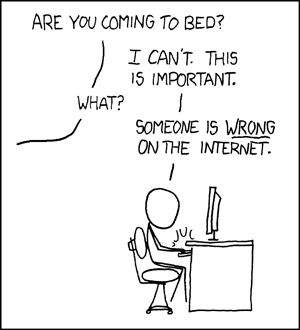
What to do when Facebook arguments suck you in

It's happened again: someone's made an inflammatory comment on what's clearly a totally reasonable Facebook post, and you feel your response buzzing in your fingertips. You have two choices: let them have it ("it" being a polite and measured rebuttal, of course) or walk away. The problem is that neither approach is really satisfying.

The problem with engaging


About a decade ago, I used to get in a lot of arguments on the internet. Back then, the debates I dived into were mostly academic, like whether a "neutral" English accent exists, or whether a plane really could take off from a treadmill (the latter, ironically, on the xkcd forums). The amazing thing is that even when you explain to someone that they're wrong, why they're wrong, and how they can be right in the future, they still don't change their mind! They can even seem more convinced of their own position than when you started. So why engage when it's a waste of time?

The problem with ignoring


There's one obvious problem with walking away: someone is still wrong on the internet. But there are subtler problems too. When we pay more attention to content with a worldview similar to our own, algorithms like Facebook's are designed to show us more of that. And when we see less and less of people who disagree with us, it's easier to reduce their views in our minds to simplified caricatures, really held by no reasonable person.


"You don't decide what gets in. And more importantly, you don't actually see what gets edited out."
But we don't even need an algorithm for this to happen. Even if we like having a mixture of perspectives in our lives, a slight desire not to be the odd one out can cause us to naturally segregate ourselves—for an interactive blog post on this idea, see the Parable of the Polygons, an allegory of small individual bias leading to large-scale intolerance.


I wonder whether these effects have to do with the rising levels of political polarization in the U.S. over the last decade.

So what can you do? If ignoring people creates division, and engaging doesn't necessarily help either, what's left?

Listen


It's easy to skim and jump straight into respond-mode. It's harder to pause and ask yourself what's going on in your friend's head—are they feeling angry? Frustrated? Hopeless? Even better: make a guess, and ask if you're right! "It sounds like you're worried that... Is that right?" You may find that there's something else going on than you thought.

And sometimes, showing that you're willing to hear their point of view means that they will spontaneously reciprocate. Since I resolved more often to reflect the desires people were expressing, I was surprised how often I found out they already were considering the viewpoint I'd wanted to share.

But since that doesn't always happen, I like to let go of the idea that victory is making sure your view is the last one heard. If everyone has that goal, no one wins. Instead, reaching a target of just one moment of understanding—even if it's you understanding them—is satisfying and leaves the internet a better place.

If you still feel the need to respond...


Okay, so sometimes you really, really want to make sure your views are also expressed. How can you do that without escalating to frustration?

  •  Dress your opponent as Iron Man

A straw man is when you attack a weaker version of someone's argument, so that you can win more easily. But the point is not to win, the point is to be right—so what's the rightest version of what they're saying? Show them that you get it, that they don't need to pull out the rhetoric in case you haven't heard it before.

  • Share information, not counterarguments.

After you've shown them that you understand where they're coming from, only then are you in a position to explain why you disagree. But in the spirit of honest communication, don't just pull out the standard rhetoric of your side. Better is to share the facts that caused you to join that side in the first place. After all, that's what convinced you.

I came across a nice summary of this conversation style in a blog post by Eli Dourado on why experts don't always agree:
Someone who is really seeking the truth should be eager to collect new information through listening rather than speaking, construe opposing perspectives in their most favorable light, and offer information of which the other parties are not aware, instead of simply repeating arguments the other side has already heard.

And while you're at it...


Part of the reason these techniques are so effective—listening carefully to the emotions underlying differing viewpoints, rephrasing your opponents' arguments to sound as honestly convincing as possible, and sharing information that might shed light on why we are disagreeing—is that they have the uncomfortable benefit of making it more likely for us to change our own minds in the process. Because we all have to be willing, at least a little bit, to change our minds, if you want our friends to do so too.

Sunday, July 3, 2016

"Already" and "yet"

It's funny how a small shade of meaning can color a whole sentence. Compare these two questions:


  • Have you taken out the trash yet?
  • Have you taken out the trash already?


These two questions mean exactly the same thing, in that the answer to one will be Yes or No exactly if the answer to the other is too.

But what comes with that Yes or No? A Yes answer to the first question means that you have met the questioner's expectations. A No means that you failed. But for the second question, it's less clear what the expectations are: does the questioner have something else they want to stick in the garbage before it goes out? Or are they heading outside anyway and wondering if they can take the trash on the way?

I like to use "already" instead of "yet" in sentences like these, because I try to keep expectations and judgements out of questions where I really am just interested in the answer. Here's another case where "already" can alleviate the tension of not meeting the asker's expectations:


  • What's your next blog post going to be about?
  • Have you already chosen a topic for your next blog post?


If you haven't chosen a topic yet, the second question is much nicer to answer.  Here are some more examples:


  • When are you going back to Europe?
  • Have you already made plans to visit Europe again?

  • Where are you going to live in Minneapolis?
  • Have you already found a place to live in Minneapolis?


(The answer to that question, by the way, is Yes! We're excited to get there and show you around like we did for this apartment.)

Let me close by saying that I don't have anything against the word "yet." In fact, I get quite a boost from appending it to negative statements about my ability:


  • I don't know any martial arts... yet.
  • I can't read French very well... yet.
  • I'm not very good at drawing... yet.


I say this about a skill even when I don't have any plans for learning it... yet!

Sunday, June 26, 2016

Health is not a virtue

I was a healthy child. I had a healthy immediate family, too. We all got sick occasionally, and my sisters and I have all broken a bone at some point, but we just weren't the sort of people to have chronic ailments or other serious health concerns. At least, that's the best I could muster to explain my surprise each time when, over the years, we've had cases of autoimmune disorders, anxiety and depression, and cancer. So I'd like to correct my impression that health, like other positive qualities, is a virtue.

Health is not a virtue.

Health can be a consequence of conscientious behavior, but is not a reward for it. Taking meticulous care of oneself might not be enough to ensure good health, so even those who work hard for their health cannot take 100% credit for it. As far as my thinking goes, I'm going to try to detach the fortuity of good health from the virtuous behavior of creating a healthy environment for myself and the people around me.

Beauty is not a virtue.

I feel pressure to conform to cultural stereotypes of beauty, but what's the point? To give people something nicer to look at? What I really want is the value people ascribe to those who are beautiful. What if instead we valued people who make others feel good about themselves, free to admit their insecurities without fear of judgement?

Youth is not a virtue.

Somehow, as a child, I had the never-fully-expressed, even to myself, idea that old people were that way because they deserved to be. That I, of course, would never be old, because I am young and therefore deserve to be. I remember the first time I saw a photograph of my grandfather when he was my dad's age—that was the first time I really understood that (if all goes well) I would sometimes be my parents' age, and they my grandparents' age, and I too would grow wrinkly and white-haired. I would like to think of the elderly not as a different species, but as a wise group of people whom I would like to join and from whom I can already be learning.

Intelligence is not a virtue.

My intelligence has been a central part of my identity for as long as I can remember. I like a mental challenge much more than a physical one (although that's no longer as true as it once was), and I'd much rather read and think than speak and do. But when wanting to appear intelligent keeps me from speaking up when I don't understand, or trying something hard that I might fail at, not only do I lose out, but so does everyone else who might benefit from my input. Instead of valuing intelligence as a virtue initself, I propose that the truly virtuous are those who put effort into solving real problems, and who make it easier for others to do so as well.

Monday, June 20, 2016

The three stages of correcting failure

James Clear recently wrote a blog post on what he calls the three stages of failure, which I found quite insightful. I'd like to respond here, so I'll briefly review his definitions and advice, and at the end I'll give some examples of failure diagnosis from a board game called 7 Wonders.

The three stages of failure:

  1. Failure of tactics. These are failures of plans falling through, and the advice for combating them is a process of measurement and review so that you can make better plans in the future.
  2. Failure of strategy. This is when you carry out your plans but they don't give the results you want. Here, the advice revolves around the idea that you may have to try several strategies before one works, so implement them one after another as quickly and cheaply as you can.
  3. Failure of vision. This kind of failure is when your plans succeed, but the success doesn't match your goal. The advice here is to reflect on what you truly want from life, and then stick to your guns when other people criticize you for working toward it.
What I'd like to add to the article is a discussion of identifying to what stage a particular failure belongs. The article includes an example where a failure of tactics could have been mistaken for a failure of vision—if work isn't going well, how can you tell whether you need a new plan or a new career? The line between tactics and strategy is also notoriously fuzzy: the New Oxford American Dictionary defines them respectively as
tactic: an action or strategy carefully planned to achieve a specific end.
strategy: a plan of action or policy designed to achieve a major or overall aim.
To me, the main difference is that tactics comprise specific decisions while strategies are broader decision-making rules. A failure of tactics, then, is when you don't achieve the specific sequence of actions you plan out, while a failure of strategy is one where your rule for making plans isn't resulting in the outcome you want.

So here's my suggested framework for identifying and correcting failures of all three types:

  1. If you're not following through on your own plans, it's a failure of tactics. Change your methods.
  2. If you're completing your plans but they're not giving the results you want, it's a failure of strategy. Change your plans.
  3. If your plans are succeeding but the results aren't aligning with your values, then it's a failure of vision. Change your goal.

Note: these must be checked in this order. You can't know whether your plans are succeeding until you can carry them out fully, and you can't know for sure whether your vision is the right one until you get close enough to see it clearly. I think this may be why Clear calls them the "stages" of failure and not just three "types."

The need to correct failures in order also explains a comment I hear regularly from self-help gurus like Ramit Sethi, who complains that people only want finance tips and tricks when he's trying to get them thinking about what it means to live a rich life. But if people are finding that they aren't following through on their plans now, it makes sense for them to want to fix that before trying to make a career change. I suspect that follow-through is such a transferable skill that it's regarded as a character trait, and that once you have it, it's easy to regard it as a neutral background on which the "real" struggles of strategy and vision play out. This reminds me of Scott H. Young's thoughts on the role of free will in success:
[That free will counts for more, the less unlikely success is,] may help explain why so many obviously advantaged people primarily credit effort for their successes. From their perspective, it was effort that mattered. Since they actually had reasonable chances to succeed, strength of conviction of the choice made to pursue it became a dominant variable, even if for most people it isn’t.
If you're at the level where fixing failures of tactics is second nature to you, then whether or not you can fix failures of strategy or vision is what matters. But if you're not at the level where you can follow through on your basic plans, then no amount of visionary introspection will help.


I'd like to end with some examples of failure diagnosis from a board game called 7 Wonders. Here's how 7 Wonders works if you don't know it: Every round, each player chooses a card from their hand to add to their civilization, then passes the remaining cards to their neighbor. Early in the game, these cards are mostly materials like wood, stone, or cloth, and later many of the cards require you to have access to several of these materials in order to "build" them. (If you don't have the resources you need, you can also use the ones your neighbors have—for a small fee.) These more expensive cards give you points, and the winner at the end of the game is the one with the most points.

Failure A: Perhaps you know that the green "science" cards are worth a lot of points if you can collect several of them, so you decide that every time you get a science card you can play, you'll do so. At the end of the game, you have accrued a respectable array of science cards, but most of your points are in this one area and it wasn't enough to win you the game. What kind of failure was this? It's a failure of strategy: you successfully followed your decision-making rule, but you didn't achieve your goal of winning. So try changing your plan. Perhaps in a small way—at the end of the game, an additional science card may not increase your points by as much as some of the other cards, so you decide that in Age III you'll relax your buy-science rule and just get whatever card is worth the most points at that moment—or perhaps you'll try another strategy entirely and focus on having access to enough resources to buy whatever cards you want at any time.

Failure B: Now let's say that your plan is to get points by completing "phases of your wonder," which have a fixed cost like other buildings you might want. The final phase is often very expensive, perhaps requiring four copies of a single resource, like stone. You go to build it, and discover to your chagrin that there isn't enough stone between you and your neighbors to accomplish it. What kind of failure was this? You didn't follow through on a plan you made, so this is a failure of tactics. So try implementing a new habit: at the beginning of the game, when collecting the resources you will need later, keep an eye on what your neighbors have, both to make sure a couple of each resource will be available to you later, and also enough of the single resource you will need if you want to complete all the phases of your wonder.

Failure C: You've tried various strategies, and are starting to win the game more frequently. But some of those strategies, like playing cards solely to keep other players from benefiting from them, bring you closer to your goal of winning but are making the game less fun. (If this doesn't sound like you, just imagine you're me.) What kind of failure is this? Your plans are succeeding, but the outcome isn't what you thought it would be. This is a failure of vision. So change your goal: perhaps play to maximize the number of points you have at the end, instead of your probability of winning. This means that you devote less effort to screwing over the other players, and lends itself more to playing against your past and future performance. Not comparing myself to others, only to my past and future selves, is a habit I try to cultivate anyway, so this way of playing fits better with my personal values.

Monday, May 16, 2016

"Should" without the anxiety

  • I should be saving more.
  • I should be traveling more.
  • I should wash the dishes.
  • I should figure out what I want to do with my life.
  • I should read more books.
Statements like these flit through my mind all the time. Clara wrote a few months ago about the way "should" statements induce anxiety: Whenever I book a flight, the "Can I afford this?" voice pipes up accusingly, and whenever do I sock away money for a rainy day, I worry that I'm not enjoying the sunny ones enough.

But here's something Clara and I have been doing lately to soften those "should" statements: add an "if."  Compare:
  • I should be saving more.
  • If I want to have more money set aside for emergencies, I should save more.
Or:
  • I should be traveling more.
  • If I want to have a more varied experience in Europe, I should be traveling more.
When I articulate why I would want to save or travel, getting the underlying desires out in the open, it makes the conflict between those desires and not between the actions they demand.  Rather than choosing the lesser of two guilty feelings when I'm deciding where a dollar goes, I can let my desires for variety and security reach a compromise, like "It's okay to spend Y per month on travel if I'm on target to save up X months of rent in case I lose my job."  Knowing that all my inner voices are heard is a great relief.

Sometimes, the exercise of adding an "if I want" is helpful in other ways.
  • I should do the dishes now if I want to have the counter clear to prep food on later.
Just visualizing the outcome I want can make it easier to get off my bum and do it.
  • If I want my life to have a clear path, I should figure out what I want to do with it.
I do want to know where my life is going, but even the best plans don't always work out.  When I accept that nothing in the future is certain, I feel less anxious about the vague need to "figure things out."

And sometimes, adding on an "if I want" is just silly:
  • I should read more books if I ... want to read more books?
Poof!  There goes the guilt about not reading enough.  I read for fun, not because I should!

This adapts well to "You should" statements too, by adding an "if you want."  Which of these would you rather hear?
  • You should defrost your freezer!
  • If you want more space in your freezer, you should defrost it.
Why yes, I do want more space in my freezer!  But that's just one of many wants, and I don't need to act on them all right now.

I try to make sure I phrase my exhortations this way, to give someone an out if their priorities are different from mine.  Telling a student "If you want this passage in your thesis to be clearer, you should add more exposition" goes over much better with the "if" clause than without, if they turn out to be worried about exceeding the thesis page limit.  And when I hear "You should...", tacking on an invisible "if I want..." in my mind makes it much easier to keep from getting angry that people don't understand my unique situation.

To sum up, here's my attempt at a tweet-able epigram:

If you want to say "should," you should say "If you want."
(Click to tweet)

Friday, February 26, 2016

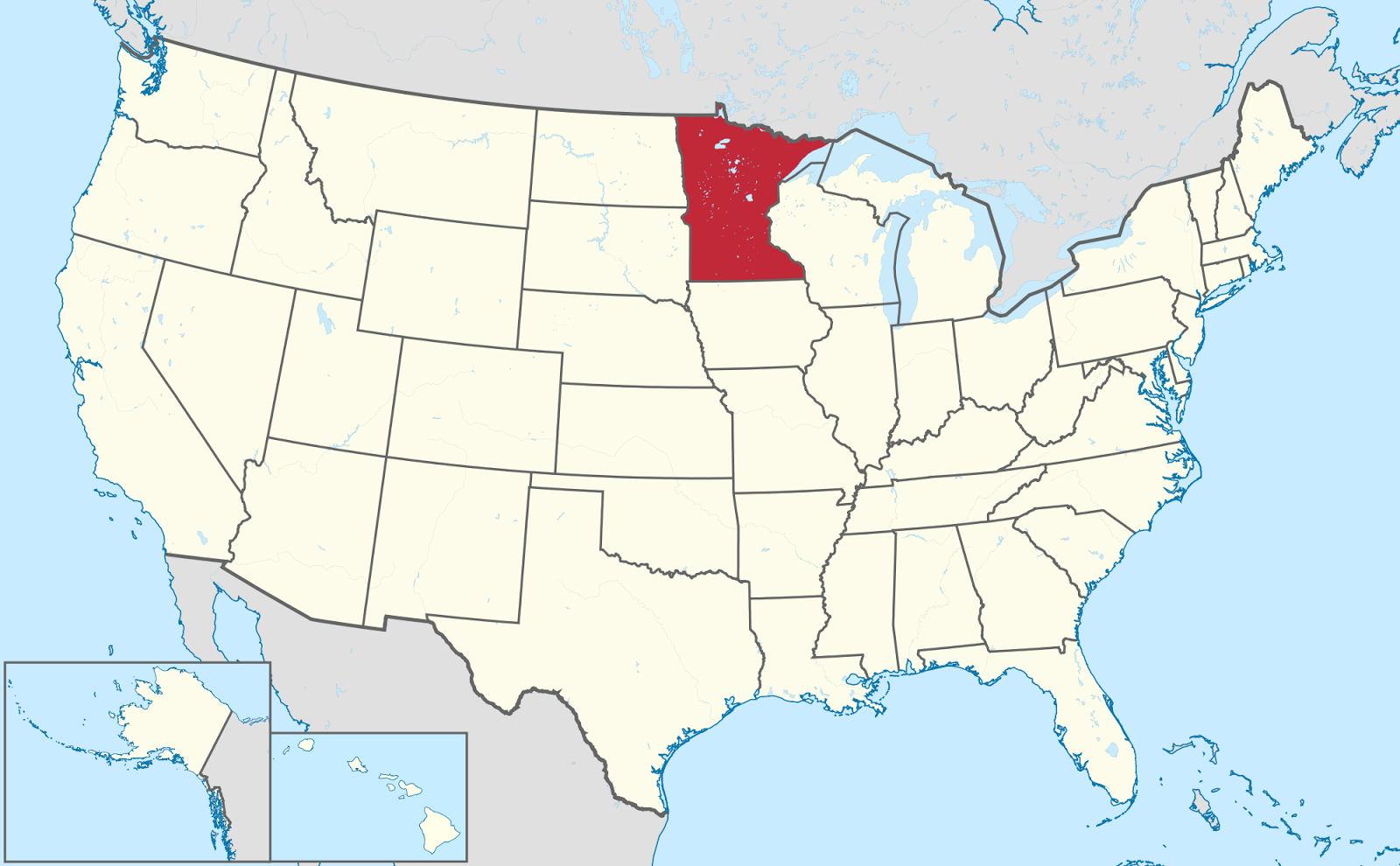
Moving to Minnesota!

This beautiful photo was available through m01229's flicker
This week, Owen and I decided to move to Minneapolis. The University of Minnesota English department has offered me a PhD position, which essentially means I will be paid to study and teach Shakespeare. This is a great joy. This is what I want to spend my whole life doing. This is reason enough to move, but there are many other reasons I'm excited for this new place to call home.

For my European friends: That's Minnesota.
One reason is a strangely sentimental layover from an odd chance on a new year's eve. When I was in grad school and Owen and I were still just dating I was supposed to fly out and spend the week with him and his family in Seattle. There was a blizzard in NYC, and my flight scheduled to go through JFK was cancelled, so I had to find a different flight through Minneapolis. As we landed it was a perfectly clear night and I got to see the sudden skyscrapers of the twin cities all lit and beautiful, and heard a mother from a seat behind me asking her daughter, "does it look like home?", in a comforting, midwest accent. And I was just a little overwhelmed that I was getting a glimpse of the place my parents had spent eight years of their lives. It was a 20 minute layover, but I think of it six years later with a great deal of fondness.

I can imagine you thinking, "So your parents lived there for a bit, and you have a happy memory of a layover there. What else is nice about Minneapolis? Isn't it just supposed to be super-extra cold?" I mean, yes. Yes, it is. But I like winter. I've dressed as winter at a costume party, and I grew up in Rochester, NY which has fierce winters. Not as cold as the midwest, I grant you, but cold enough to know it and miss it in the years I've been away. Yesterday it got below freezing here and I was so happy to be out biking in the snow I found myself singing out loud.


(If you're not convinced but want to look at lots of beautiful wintery pictures click here:  http://www.captureminnesota.com/galleries/1915)


This happiness, (however naive) is a great thing, because Minneapolis is one of the best cities for biking in the US, even ranks internationally in top 20 lists for biking cities, even considering the fact that it has brutally cold winters! You can read about one author's incredulity on this matter here. Their extensive bike-only freeways, their financial investment in making biking safe in the city, a prospering bike-share program, and mentality that biking is normal and expected make it much safer than elsewhere in the US.


People in Minneapolis are not just bikers, they're also readers. They're regularly listed as some of the most literate of American cities, ranked number one this past year by USA Today. I don't know how much time I'll have for pleasure reading on top of my regular coursework, but it will be such a joy to be able to be inside libraries of books I can read, and be surrounded by people who care about reading. And check out the beautiful new Minneapolis Central Library!

This will be me. 
There's such a great cultural scene in the Twin Cities! So much great theater! With a fringe festival! And Music! And excellent public radio! Although I am a little crushed to be moving to Minneapolis just as Garrison Keillor may be retiring from hosting A Prairie Home Companion (a radio show I grew up with, thanks to my parents' years in MN). In case you do not yet know the sound of Keillor's voice, let me introduce you via the Writer's Almanac.

We won't leave until the summer, but wherever live takes us, be it Minnesota or beyond, I hope to (as they say on the show) be well, do good work, and keep in touch.