Grown-ups like numbers. When you tell them about a new friend, they never ask questions about what really matters. They never ask: "What does his voice sound like?" "What games does he like best?" "Does he collect butterflies?". They ask: "How old is he?" "How many brothers does he have?" "How much does he weigh?" "How much money does his father make?" Only then do they think they know him.
---Antoine de Saint-Exupéry
"I should hang onto this piece of paper, but I don't want to get out the filing stuff..."
"I should get out the packing list and double-check, but I'm pretty sure I've got everything..."
"If I leave now, I'll be early, so I'll get back on the computer and try to just check one thing this time..."
I hate thoughts like these, because later, when I need that paper and can't find it, forget the pajamas, and find myself running late, my brain remembers and says, "See? You knew better!" It makes me feel so stupid. In fact, that's what I say, out loud and to myself: "I feel so stupid!" But there are a couple reasons why I don't like this phrase and want to handle the situation differently:
Stupidity is not a feeling.
I know that I am fast at some things and slow at others, and that the former is generally more pleasant, but strictly speaking, "smart" and "stupid" aren't in themselves feelings. Why is this useful to point out? Because there's nothing I can do about my intelligence, but I can address the causes of my actual feelings. In this case, those feelings are usually shame over having made a mistake at all, and disappointment because I expect myself to be someone who doesn't make the same mistake twice.
Intelligence is not a virtue.
I talked about this idea a little before, but it's something I have to keep reminding myself. My worth doesn't come from my intelligence or history of good decisions. I don't have to earn my right to exist. The sooner I can stop beating myself up about whether I'm as smart as I think I should be, the sooner I can focus on what I can actually do to make a difference next time.
For example,
I can designate a place for important papers to go temporarily, and then file them in batches when I have the time.
I can store the packing list inside my suitcase so I don't have to consciously go get it when I'm packing.
I can keep a book in my bag so it doesn't matter if I get somewhere early.
These sound like smart things to do! But notice that these methods are all ways of making up for something that is harder for me than I wish it were, like leaving on time or putting things where they belong. In order to do so, I have to first accept that I am not great at everything, and that I don't need to be. Only then can I hope to improve for next time.
I love yarn. I love blank journals. I love new boxes of crayons. But when it comes time to cast on for a knitting project, put pen to page, or make the first waxy mark on a clean sheet of paper, I hesitate, vacillate, and procrastinate. Why?
These objects embody creative potential. That yarn could become a cozy sweater or a pair of mittens, that journal could be for research or sketching or the things I encounter that surprise me. But as long as I haven't started, these are all still possibilities. So to get myself to get started, this is what I say:
To create is to commit.
You can't erase crayon, and you can't be creative without making some irreversible choices. Sure, most word processors let you hit backspace, and unknitting isn't that hard either, but eventually you will have to hit submit, or wash and block your finished garment. The potential in yarn and paper is only there if you can choose to do something with it.
This is why I'm writing a blog post here every week. I've "started" several blogs with no blog posts because I haven't decided yet what I want my theme to be. Life? Habits? Communication? Books? Math? I could dither forever. But waiting to start until I have the perfect idea will mean I never start, so I'm starting before I feel ready, and I'll figure it out as I go. And then every week, I wonder whether one of my other post ideas would be more timely or important than the one I'm working on, and equally whether maybe I should wait to post that one until I can really do it justice. So I tell myself that to create is to commit, just pick whatever topic I feel like I can manage to write about in one weekend, and do it whether what I make is any good or not.
I am very glad to have left this blog in my husbands' immensely capable hands, while I've been doing other projects, but today I am tired and frustrated with moving nonsense, and I was thinking about dolls and I had a revelation about how my childhood could have been much, much cooler.
I, like many middle class girls growing up in the 90s, had an American Girl doll. I had Samantha, the awesome, give women the vote and stand up against child labor, rich, orphaned little lady who lived with her grandmother. I thought she was marvelous, even though her hair didn't match mine because she clearly had the best clothes and my mom did a ton of work making all her outfits for me. I really loved her, and was super impressed with how beautiful she was, but I struggled a little with... how to play with her?
I had several other much less expensive dolls from various birthday parties or whatnot who were all the same size and would all play together... but Samantha was so much bigger than my other dolls and came prepackaged with such a strong story that I struggled to add to it, or mix her in with dolls with dresses from no particular era, but certainly not 1900s America. Even when I got together with friends and brought Samantha it was hard to play with her, even if the other girl also had an American Girl doll, because how can Samantha play with Kirsten? Kirsten died years before Samantha was born! Kirsten doesn't even speak English, she speaks Swedish, and... they lived in such different worlds... what could they possibly do together? I mean, you can just pretend that Samantha is not Samantha and dress her up in Kirsten's clothes and pretend they're both living out on the prairie and act out some of the stories from Kirsten's books, but... that never seemed like fun. Besides, Samantha's clothes are undeniably the prettiest.
HOWEVER. Today I had the revelation of how I could have played as a child with other friends who had dolls from different historical periods. Clearly the American Girl Dolls should be time travelers. Then Kirsten and Samantha (and Addie and Felicity and Molly and no one else because the others don't count) could all travel through time and space and learn lessons, celebrate holidays, and save the day as a team. We could have taken our dolls to whatever place or time period we happened to be learning about. Who says these girls all have to stay in America!?
This was my revelation. I don't feel a burning need to go play with my childhood toys now, but I do kind of want to read some fanfic adventure stories.
It's happened again: someone's made an inflammatory comment on what's clearly a totally reasonable Facebook post, and you feel your response buzzing in your fingertips. You have two choices: let them have it ("it" being a polite and measured rebuttal, of course) or walk away. The problem is that neither approach is really satisfying.
The problem with engaging
About a decade ago, I used to get in a lot of arguments on the internet. Back then, the debates I dived into were mostly academic, like whether a "neutral" English accent exists, or whether a plane really could take off from a treadmill (the latter, ironically, on the xkcd forums). The amazing thing is that even when you explain to someone that they're wrong, why they're wrong, and how they can be right in the future, they still don't change their mind! They can even seem more convinced of their own position than when you started. So why engage when it's a waste of time?
The problem with ignoring
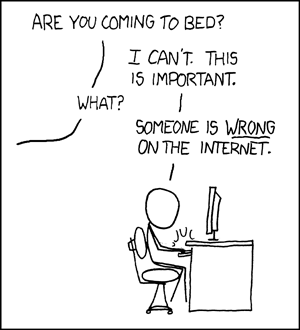
There's one obvious problem with walking away: someone is still wrong on the internet. But there are subtler problems too. When we pay more attention to content with a worldview similar to our own, algorithms like Facebook's are designed to show us more of that. And when we see less and less of people who disagree with us, it's easier to reduce their views in our minds to simplified caricatures, really held by no reasonable person.
"You don't decide what gets in. And more importantly, you don't actually see what gets edited out."
But we don't even need an algorithm for this to happen. Even if we like having a mixture of perspectives in our lives, a slight desire not to be the odd one out can cause us to naturally segregate ourselves—for an interactive blog post on this idea, see the Parable of the Polygons, an allegory of small individual bias leading to large-scale intolerance.
So what can you do? If ignoring people creates division, and engaging doesn't necessarily help either, what's left?
Listen
It's easy to skim and jump straight into respond-mode. It's harder to pause and ask yourself what's going on in your friend's head—are they feeling angry? Frustrated? Hopeless? Even better: make a guess, and ask if you're right! "It sounds like you're worried that... Is that right?" You may find that there's something else going on than you thought.
And sometimes, showing that you're willing to hear their point of view means that they will spontaneously reciprocate. Since I resolved more often to reflect the desires people were expressing, I was surprised how often I found out they already were considering the viewpoint I'd wanted to share.
But since that doesn't always happen, I like to let go of the idea that victory is making sure your view is the last one heard. If everyone has that goal, no one wins. Instead, reaching a target of just one moment of understanding—even if it's you understanding them—is satisfying and leaves the internet a better place.
If you still feel the need to respond...
Okay, so sometimes you really, really want to make sure your views are also expressed. How can you do that without escalating to frustration?
Dress your opponent as Iron Man
A straw man is when you attack a weaker version of someone's argument, so that you can win more easily. But the point is not to win, the point is to be right—so what's the rightest version of what they're saying? Show them that you get it, that they don't need to pull out the rhetoric in case you haven't heard it before.
Share information, not counterarguments.
After you've shown them that you understand where they're coming from, only then are you in a position to explain why you disagree. But in the spirit of honest communication, don't just pull out the standard rhetoric of your side. Better is to share the facts that caused you to join that side in the first place. After all, that's what convinced you.
I came across a nice summary of this conversation style in a blog post by Eli Dourado on why experts don't always agree:
Someone who is really seeking the truth should be eager to collect new information through listening rather than speaking, construe opposing perspectives in their most favorable light, and offer information of which the other parties are not aware, instead of simply repeating arguments the other side has already heard.
And while you're at it...
Part of the reason these techniques are so effective—listening carefully to the emotions underlying differing viewpoints, rephrasing your opponents' arguments to sound as honestly convincing as possible, and sharing information that might shed light on why we are disagreeing—is that they have the uncomfortable benefit of making it more likely for us to change our own minds in the process. Because we all have to be willing, at least a little bit, to change our minds, if you want our friends to do so too.
It's funny how a small shade of meaning can color a whole sentence. Compare these two questions:
Have you taken out the trash yet?
Have you taken out the trash already?
These two questions mean exactly the same thing, in that the answer to one will be Yes or No exactly if the answer to the other is too.
But what comes with that Yes or No? A Yes answer to the first question means that you have met the questioner's expectations. A No means that you failed. But for the second question, it's less clear what the expectations are: does the questioner have something else they want to stick in the garbage before it goes out? Or are they heading outside anyway and wondering if they can take the trash on the way?
I like to use "already" instead of "yet" in sentences like these, because I try to keep expectations and judgements out of questions where I really am just interested in the answer. Here's another case where "already" can alleviate the tension of not meeting the asker's expectations:
What's your next blog post going to be about?
Have you already chosen a topic for your next blog post?
If you haven't chosen a topic yet, the second question is much nicer to answer. Here are some more examples:
When are you going back to Europe?
Have you already made plans to visit Europe again?
Where are you going to live in Minneapolis?
Have you already found a place to live in Minneapolis?
(The answer to that question, by the way, is Yes! We're excited to get there and show you around like we did for this apartment.)
Let me close by saying that I don't have anything against the word "yet." In fact, I get quite a boost from appending it to negative statements about my ability:
I don't know any martial arts... yet.
I can't read French very well... yet.
I'm not very good at drawing... yet.
I say this about a skill even when I don't have any plans for learning it... yet!
I was a healthy child. I had a healthy immediate family, too. We all got sick occasionally, and my sisters and I have all broken a bone at some point, but we just weren't the sort of people to have chronic ailments or other serious health concerns. At least, that's the best I could muster to explain my surprise each time when, over the years, we've had cases of autoimmune disorders, anxiety and depression, and cancer. So I'd like to correct my impression that health, like other positive qualities, is a virtue.
Health is not a virtue.
Health can be a consequence of conscientious behavior, but is not a reward for it. Taking meticulous care of oneself might not be enough to ensure good health, so even those who work hard for their health cannot take 100% credit for it. As far as my thinking goes, I'm going to try to detach the fortuity of good health from the virtuous behavior of creating a healthy environment for myself and the people around me.
Beauty is not a virtue.
I feel pressure to conform to cultural stereotypes of beauty, but what's the point? To give people something nicer to look at? What I really want is the value people ascribe to those who are beautiful. What if instead we valued people who make others feel good about themselves, free to admit their insecurities without fear of judgement?
Youth is not a virtue.
Somehow, as a child, I had the never-fully-expressed, even to myself, idea that old people were that way because they deserved to be. That I, of course, would never be old, because I am young and therefore deserve to be. I remember the first time I saw a photograph of my grandfather when he was my dad's age—that was the first time I really understood that (if all goes well) I would sometimes be my parents' age, and they my grandparents' age, and I too would grow wrinkly and white-haired. I would like to think of the elderly not as a different species, but as a wise group of people whom I would like to join and from whom I can already be learning.
Intelligence is not a virtue.
My intelligence has been a central part of my identity for as long as I can remember. I like a mental challenge much more than a physical one (although that's no longer as true as it once was), and I'd much rather read and think than speak and do. But when wanting to appear intelligent keeps me from speaking up when I don't understand, or trying something hard that I might fail at, not only do I lose out, but so does everyone else who might benefit from my input. Instead of valuing intelligence as a virtue initself, I propose that the truly virtuous are those who put effort into solving real problems, and who make it easier for others to do so as well.
James Clear recently wrote a blog post on what he calls the three stages of failure, which I found quite insightful. I'd like to respond here, so I'll briefly review his definitions and advice, and at the end I'll give some examples of failure diagnosis from a board game called 7 Wonders.
The three stages of failure:
Failure of tactics. These are failures of plans falling through, and the advice for combating them is a process of measurement and review so that you can make better plans in the future.
Failure of strategy. This is when you carry out your plans but they don't give the results you want. Here, the advice revolves around the idea that you may have to try several strategies before one works, so implement them one after another as quickly and cheaply as you can.
Failure of vision. This kind of failure is when your plans succeed, but the success doesn't match your goal. The advice here is to reflect on what you truly want from life, and then stick to your guns when other people criticize you for working toward it.
What I'd like to add to the article is a discussion of identifying to what stage a particular failure belongs. The article includes an example where a failure of tactics could have been mistaken for a failure of vision—if work isn't going well, how can you tell whether you need a new plan or a new career? The line between tactics and strategy is also notoriously fuzzy: the New Oxford American Dictionary defines them respectively as
tactic: an action or strategy carefully planned to achieve a specific end. strategy: a plan of action or policy designed to achieve a major or overall aim.
To me, the main difference is that tactics comprise specific decisions while strategies are broader decision-making rules. A failure of tactics, then, is when you don't achieve the specific sequence of actions you plan out, while a failure of strategy is one where your rule for making plans isn't resulting in the outcome you want.
So here's my suggested framework for identifying and correcting failures of all three types:
If you're not following through on your own plans, it's a failure of tactics. Change your methods.
If you're completing your plans but they're not giving the results you want, it's a failure of strategy. Change your plans.
If your plans are succeeding but the results aren't aligning with your values, then it's a failure of vision. Change your goal.
Note: these must be checked in this order. You can't know whether your plans are succeeding until you can carry them out fully, and you can't know for sure whether your vision is the right one until you get close enough to see it clearly. I think this may be why Clear calls them the "stages" of failure and not just three "types."
The need to correct failures in order also explains a comment I hear regularly from self-help gurus like Ramit Sethi, who complains that people only want finance tips and tricks when he's trying to get them thinking about what it means to live a rich life. But if people are finding that they aren't following through on their plans now, it makes sense for them to want to fix that before trying to make a career change. I suspect that follow-through is such a transferable skill that it's regarded as a character trait, and that once you have it, it's easy to regard it as a neutral background on which the "real" struggles of strategy and vision play out. This reminds me of Scott H. Young's thoughts on the role of free will in success:
[That free will counts for more, the less unlikely success is,] may help explain why so many obviously advantaged people primarily credit effort for their successes. From their perspective, it was effort that mattered. Since they actually had reasonable chances to succeed, strength of conviction of the choice made to pursue it became a dominant variable, even if for most people it isn’t.
If you're at the level where fixing failures of tactics is second nature to you, then whether or not you can fix failures of strategy or vision is what matters. But if you're not at the level where you can follow through on your basic plans, then no amount of visionary introspection will help.
I'd like to end with some examples of failure diagnosis from a board game called 7 Wonders. Here's how 7 Wonders works if you don't know it: Every round, each player chooses a card from their hand to add to their civilization, then passes the remaining cards to their neighbor. Early in the game, these cards are mostly materials like wood, stone, or cloth, and later many of the cards require you to have access to several of these materials in order to "build" them. (If you don't have the resources you need, you can also use the ones your neighbors have—for a small fee.) These more expensive cards give you points, and the winner at the end of the game is the one with the most points.
Failure A: Perhaps you know that the green "science" cards are worth a lot of points if you can collect several of them, so you decide that every time you get a science card you can play, you'll do so. At the end of the game, you have accrued a respectable array of science cards, but most of your points are in this one area and it wasn't enough to win you the game. What kind of failure was this? It's a failure of strategy: you successfully followed your decision-making rule, but you didn't achieve your goal of winning. So try changing your plan. Perhaps in a small way—at the end of the game, an additional science card may not increase your points by as much as some of the other cards, so you decide that in Age III you'll relax your buy-science rule and just get whatever card is worth the most points at that moment—or perhaps you'll try another strategy entirely and focus on having access to enough resources to buy whatever cards you want at any time.
Failure B: Now let's say that your plan is to get points by completing "phases of your wonder," which have a fixed cost like other buildings you might want. The final phase is often very expensive, perhaps requiring four copies of a single resource, like stone. You go to build it, and discover to your chagrin that there isn't enough stone between you and your neighbors to accomplish it. What kind of failure was this? You didn't follow through on a plan you made, so this is a failure of tactics. So try implementing a new habit: at the beginning of the game, when collecting the resources you will need later, keep an eye on what your neighbors have, both to make sure a couple of each resource will be available to you later, and also enough of the single resource you will need if you want to complete all the phases of your wonder.
Failure C: You've tried various strategies, and are starting to win the game more frequently. But some of those strategies, like playing cards solely to keep other players from benefiting from them, bring you closer to your goal of winning but are making the game less fun. (If this doesn't sound like you, just imagine you're me.) What kind of failure is this? Your plans are succeeding, but the outcome isn't what you thought it would be. This is a failure of vision. So change your goal: perhaps play to maximize the number of points you have at the end, instead of your probability of winning. This means that you devote less effort to screwing over the other players, and lends itself more to playing against your past and future performance. Not comparing myself to others, only to my past and future selves, is a habit I try to cultivate anyway, so this way of playing fits better with my personal values.