Grown-ups like numbers. When you tell them about a new friend, they never ask questions about what really matters. They never ask: "What does his voice sound like?" "What games does he like best?" "Does he collect butterflies?". They ask: "How old is he?" "How many brothers does he have?" "How much does he weigh?" "How much money does his father make?" Only then do they think they know him.
---Antoine de Saint-Exupéry
We did a lot of walking around on the last few days we were in Leiden, for a couple reasons:
We had to transport several large objects (including four suitcases and a couch) across the city, which meant lots of walking to and fro.
On our last day, we sold our bikes as one of our earlier errands, so everywhere else we went that day (Hortus Botanicus, De Valk, etc.) we visited on foot.
These were reasons of necessity, but I really appreciated having the opportunity to notice new things about Leiden that I never had before. For example, over many front doors there there are rectangles of glass spanned by arcing dividers, and I made it a project during these walking adventures to photograph as many as I could spot. Here are a few of my favorites:
I love the way every one is different, but they are all stylistically unified. And all so beautiful.
How about you? Have you ever made a happy discovery because you were forced to go at a slower pace than you were used to?
I noticed recently that I've been trying to live my life according to two conflicting principles. On the one hand, I am always trying to give my life the structure of good habits. I journal every day, I write a blog post once a week, and I am currently working on the habit of washing my glasses every morning. I like not having to make the decision every day; instead, I made the decision once and act on it again and again, preferably without having to think about it.
On the other hand, I want to fill my life with a variety of different experiences. I suspect that life seems to go by faster the more each day is filled with familiar things one can experience without noticing: unlike our first few months here in Leiden, when everything was new, the last year has flown by at a terrifying rate. And sometimes a lack of variety can be dangerous: eating the same thing all the time can lead to vitamin deficiencies, and exercising only some muscle groups can lead to imbalances.
I haven't yet fully sorted through how much I want to do intentionally and how much I would like to mentally automate. But it occurred to me that it's also possible for a habit to promote variety in one's life. For example, a friend of Clara's planned her meals around whatever organic produce was on sale that week. That simple rule allowed her to eat a variety of fruits and vegetables from week to week without having to specifically plan out a rotation.
Then I realized that I had developed some habits of variety myself without realizing it. There are several ways to bike from our apartment to the opposite side of Leiden, and instead of going the same way every time, I fell into the rhythm of going one way when on my way to work, another way on my way to Dutch class, and a third way for Bible Study, even though it didn't make much difference to the travel time. That way I'd keep visiting different parts of our beautiful city without having to plan it.
I also exercise using an ipad app that takes you through a different combination of exercises every time you use it, and which is designed to gradually ramp up in overall difficulty as you get stronger. In the past I've gotten bored by exercise routines that are basically the same week after week, but this method has let me practice both consistency and variety in my physical fitness.
In each case, the habit is tied to a regular trigger that varies: which produce is on sale, or what day of the week it is, or what exercise the app tells me to do next. I think that's the key to making the behavior both habitual and varied.
Here are some other areas of my life into which I'm thinking of incorporating more habitual variety. Suggestions are welcome!
Fun spending:
It's inefficient to spend money on the same fun activities every week if the fun gradually diminishes. What are some ways I can make sure my money goes toward a variety of experiences, while still keeping to a tight budget?
Chores:
I would love for chores to be one of those habits I do without thinking. I wash the dishes every day, but how often am I supposed to dust behind the refrigerator or clean out the junk drawer? It's hard to make a habit out of things that are only necessary once in a while, so how can I make sure I'm getting to everything regularly without thinking about it too hard?
Relationships:
At this point in my life I've accrued a lot of friends from all over the world, but it takes more effort to keep in touch with the ones who are farther away. (This is especially relevant to me now, as I prepare to move to a new home over four thousand miles away.) What are some ways to habitually reach out to more of my friends, and not just the ones it's easiest to talk to?
What are your ideas? Do you have any habits of variety you've found helpful?
"I should hang onto this piece of paper, but I don't want to get out the filing stuff..."
"I should get out the packing list and double-check, but I'm pretty sure I've got everything..."
"If I leave now, I'll be early, so I'll get back on the computer and try to just check one thing this time..."
I hate thoughts like these, because later, when I need that paper and can't find it, forget the pajamas, and find myself running late, my brain remembers and says, "See? You knew better!" It makes me feel so stupid. In fact, that's what I say, out loud and to myself: "I feel so stupid!" But there are a couple reasons why I don't like this phrase and want to handle the situation differently:
Stupidity is not a feeling.
I know that I am fast at some things and slow at others, and that the former is generally more pleasant, but strictly speaking, "smart" and "stupid" aren't in themselves feelings. Why is this useful to point out? Because there's nothing I can do about my intelligence, but I can address the causes of my actual feelings. In this case, those feelings are usually shame over having made a mistake at all, and disappointment because I expect myself to be someone who doesn't make the same mistake twice.
Intelligence is not a virtue.
I talked about this idea a little before, but it's something I have to keep reminding myself. My worth doesn't come from my intelligence or history of good decisions. I don't have to earn my right to exist. The sooner I can stop beating myself up about whether I'm as smart as I think I should be, the sooner I can focus on what I can actually do to make a difference next time.
For example,
I can designate a place for important papers to go temporarily, and then file them in batches when I have the time.
I can store the packing list inside my suitcase so I don't have to consciously go get it when I'm packing.
I can keep a book in my bag so it doesn't matter if I get somewhere early.
These sound like smart things to do! But notice that these methods are all ways of making up for something that is harder for me than I wish it were, like leaving on time or putting things where they belong. In order to do so, I have to first accept that I am not great at everything, and that I don't need to be. Only then can I hope to improve for next time.
I love yarn. I love blank journals. I love new boxes of crayons. But when it comes time to cast on for a knitting project, put pen to page, or make the first waxy mark on a clean sheet of paper, I hesitate, vacillate, and procrastinate. Why?
These objects embody creative potential. That yarn could become a cozy sweater or a pair of mittens, that journal could be for research or sketching or the things I encounter that surprise me. But as long as I haven't started, these are all still possibilities. So to get myself to get started, this is what I say:
To create is to commit.
You can't erase crayon, and you can't be creative without making some irreversible choices. Sure, most word processors let you hit backspace, and unknitting isn't that hard either, but eventually you will have to hit submit, or wash and block your finished garment. The potential in yarn and paper is only there if you can choose to do something with it.
This is why I'm writing a blog post here every week. I've "started" several blogs with no blog posts because I haven't decided yet what I want my theme to be. Life? Habits? Communication? Books? Math? I could dither forever. But waiting to start until I have the perfect idea will mean I never start, so I'm starting before I feel ready, and I'll figure it out as I go. And then every week, I wonder whether one of my other post ideas would be more timely or important than the one I'm working on, and equally whether maybe I should wait to post that one until I can really do it justice. So I tell myself that to create is to commit, just pick whatever topic I feel like I can manage to write about in one weekend, and do it whether what I make is any good or not.
I am very glad to have left this blog in my husbands' immensely capable hands, while I've been doing other projects, but today I am tired and frustrated with moving nonsense, and I was thinking about dolls and I had a revelation about how my childhood could have been much, much cooler.
I, like many middle class girls growing up in the 90s, had an American Girl doll. I had Samantha, the awesome, give women the vote and stand up against child labor, rich, orphaned little lady who lived with her grandmother. I thought she was marvelous, even though her hair didn't match mine because she clearly had the best clothes and my mom did a ton of work making all her outfits for me. I really loved her, and was super impressed with how beautiful she was, but I struggled a little with... how to play with her?
I had several other much less expensive dolls from various birthday parties or whatnot who were all the same size and would all play together... but Samantha was so much bigger than my other dolls and came prepackaged with such a strong story that I struggled to add to it, or mix her in with dolls with dresses from no particular era, but certainly not 1900s America. Even when I got together with friends and brought Samantha it was hard to play with her, even if the other girl also had an American Girl doll, because how can Samantha play with Kirsten? Kirsten died years before Samantha was born! Kirsten doesn't even speak English, she speaks Swedish, and... they lived in such different worlds... what could they possibly do together? I mean, you can just pretend that Samantha is not Samantha and dress her up in Kirsten's clothes and pretend they're both living out on the prairie and act out some of the stories from Kirsten's books, but... that never seemed like fun. Besides, Samantha's clothes are undeniably the prettiest.
HOWEVER. Today I had the revelation of how I could have played as a child with other friends who had dolls from different historical periods. Clearly the American Girl Dolls should be time travelers. Then Kirsten and Samantha (and Addie and Felicity and Molly and no one else because the others don't count) could all travel through time and space and learn lessons, celebrate holidays, and save the day as a team. We could have taken our dolls to whatever place or time period we happened to be learning about. Who says these girls all have to stay in America!?
This was my revelation. I don't feel a burning need to go play with my childhood toys now, but I do kind of want to read some fanfic adventure stories.
It's happened again: someone's made an inflammatory comment on what's clearly a totally reasonable Facebook post, and you feel your response buzzing in your fingertips. You have two choices: let them have it ("it" being a polite and measured rebuttal, of course) or walk away. The problem is that neither approach is really satisfying.
The problem with engaging
About a decade ago, I used to get in a lot of arguments on the internet. Back then, the debates I dived into were mostly academic, like whether a "neutral" English accent exists, or whether a plane really could take off from a treadmill (the latter, ironically, on the xkcd forums). The amazing thing is that even when you explain to someone that they're wrong, why they're wrong, and how they can be right in the future, they still don't change their mind! They can even seem more convinced of their own position than when you started. So why engage when it's a waste of time?
The problem with ignoring
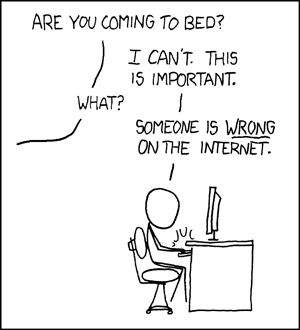
There's one obvious problem with walking away: someone is still wrong on the internet. But there are subtler problems too. When we pay more attention to content with a worldview similar to our own, algorithms like Facebook's are designed to show us more of that. And when we see less and less of people who disagree with us, it's easier to reduce their views in our minds to simplified caricatures, really held by no reasonable person.
"You don't decide what gets in. And more importantly, you don't actually see what gets edited out."
But we don't even need an algorithm for this to happen. Even if we like having a mixture of perspectives in our lives, a slight desire not to be the odd one out can cause us to naturally segregate ourselves—for an interactive blog post on this idea, see the Parable of the Polygons, an allegory of small individual bias leading to large-scale intolerance.
So what can you do? If ignoring people creates division, and engaging doesn't necessarily help either, what's left?
Listen
It's easy to skim and jump straight into respond-mode. It's harder to pause and ask yourself what's going on in your friend's head—are they feeling angry? Frustrated? Hopeless? Even better: make a guess, and ask if you're right! "It sounds like you're worried that... Is that right?" You may find that there's something else going on than you thought.
And sometimes, showing that you're willing to hear their point of view means that they will spontaneously reciprocate. Since I resolved more often to reflect the desires people were expressing, I was surprised how often I found out they already were considering the viewpoint I'd wanted to share.
But since that doesn't always happen, I like to let go of the idea that victory is making sure your view is the last one heard. If everyone has that goal, no one wins. Instead, reaching a target of just one moment of understanding—even if it's you understanding them—is satisfying and leaves the internet a better place.
If you still feel the need to respond...
Okay, so sometimes you really, really want to make sure your views are also expressed. How can you do that without escalating to frustration?
Dress your opponent as Iron Man
A straw man is when you attack a weaker version of someone's argument, so that you can win more easily. But the point is not to win, the point is to be right—so what's the rightest version of what they're saying? Show them that you get it, that they don't need to pull out the rhetoric in case you haven't heard it before.
Share information, not counterarguments.
After you've shown them that you understand where they're coming from, only then are you in a position to explain why you disagree. But in the spirit of honest communication, don't just pull out the standard rhetoric of your side. Better is to share the facts that caused you to join that side in the first place. After all, that's what convinced you.
I came across a nice summary of this conversation style in a blog post by Eli Dourado on why experts don't always agree:
Someone who is really seeking the truth should be eager to collect new information through listening rather than speaking, construe opposing perspectives in their most favorable light, and offer information of which the other parties are not aware, instead of simply repeating arguments the other side has already heard.
And while you're at it...
Part of the reason these techniques are so effective—listening carefully to the emotions underlying differing viewpoints, rephrasing your opponents' arguments to sound as honestly convincing as possible, and sharing information that might shed light on why we are disagreeing—is that they have the uncomfortable benefit of making it more likely for us to change our own minds in the process. Because we all have to be willing, at least a little bit, to change our minds, if you want our friends to do so too.
It's funny how a small shade of meaning can color a whole sentence. Compare these two questions:
Have you taken out the trash yet?
Have you taken out the trash already?
These two questions mean exactly the same thing, in that the answer to one will be Yes or No exactly if the answer to the other is too.
But what comes with that Yes or No? A Yes answer to the first question means that you have met the questioner's expectations. A No means that you failed. But for the second question, it's less clear what the expectations are: does the questioner have something else they want to stick in the garbage before it goes out? Or are they heading outside anyway and wondering if they can take the trash on the way?
I like to use "already" instead of "yet" in sentences like these, because I try to keep expectations and judgements out of questions where I really am just interested in the answer. Here's another case where "already" can alleviate the tension of not meeting the asker's expectations:
What's your next blog post going to be about?
Have you already chosen a topic for your next blog post?
If you haven't chosen a topic yet, the second question is much nicer to answer. Here are some more examples:
When are you going back to Europe?
Have you already made plans to visit Europe again?
Where are you going to live in Minneapolis?
Have you already found a place to live in Minneapolis?
(The answer to that question, by the way, is Yes! We're excited to get there and show you around like we did for this apartment.)
Let me close by saying that I don't have anything against the word "yet." In fact, I get quite a boost from appending it to negative statements about my ability:
I don't know any martial arts... yet.
I can't read French very well... yet.
I'm not very good at drawing... yet.
I say this about a skill even when I don't have any plans for learning it... yet!