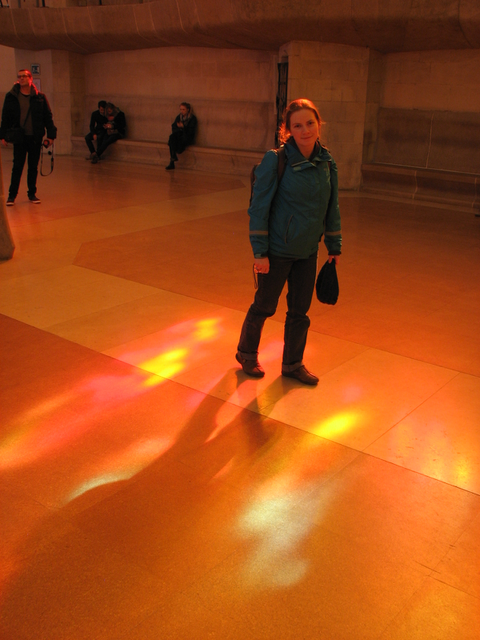
After Clara and I booked our recent trip to Rome, the airline changed our flight times and we ended up with a six-hour layover at the Barcelona airport on our way back. This airport is beautiful and calm and not a bad place to spend six hours if you want to get some work done*, but on this particular trip we wanted to make it into Barcelona proper to see at least one sight: Gaudí's masterpiece basilica, La Sagrada Família.
Our first leg landed at noon and our second was due to depart at about six pm, so we had almost exactly six hours to make it to and from the city center. The internet was not very helpful in telling us how to get there, so I'm sharing what we learned in hopes it will benefit someone else. What follows is how we spent our time, hour by hour:
12:00-12:30: Get off the plane and follow signs for public transit.
We were aiming for a bus, but found ourselves at the metro: this turned out to be a great discovery as the metro connection to the airport seems to be relatively new.
You'll need two Aeroport-metro tickets per traveller: one for the way there and one for the way back. As of this writing, each ticket costs €4.50.
12:30-1:30: Take the metro to the Sagrada Família stop.
To do this you can take the L9 Sud line all the way to Collblanc, where you ascend an infinite sequence of escalators to transfer to the L5. Take this line to the stop called Sagrada Família. We found it helpful to pass the time with games and snacks.
1:30-2:00: Eat lunch.
We got cheese, bread, fruit, nuts, and chocolate at a grocery store about a block from the Sagrada Família metro stop and ate it on a park bench. For two people for lunch it was about 10-15 euros, not bad and very speedy!
2:00-3:00: Bask in the amazing church.
You don't want to skimp on this step.
3:00-4:00: Return on the metro the way you came.
Take the L5 line to Collblanc, then transfer to the L9 Sud and go all the way to the terminal where you originally entered: For us it was Terminal 1, the last metro stop on the line. It's extra important to hold onto your metro ticket for the return trip, because you'll need to feed it into a machine both when you enter at Sagrada Família and when you leave at the airport.
4:00-6:00: Your two hours at the airport before departure.
Congratulations! You've made it there and back again.
What made this possible: We entered the basilica via the very short timed-ticket line by booking our tickets in advance. The tickets are for fifteen-minute entrance windows (we selected 2pm, so could enter anytime between 2:00 and 2:15), so we did some serious calculating trying to figure out the earliest time we could be reasonably confident of being there. Our flight was actually a half-hour late—we were supposed to have a 6.5-hour layover—so we're glad we included as much wiggle room in our estimate as we did.
*We know the Barcelona airport is so nice because our voyage to Rome had the same six-hour layover. Clara filmed one of her videos there in a spacious and nearly empty waiting area with amazing natural light, and I got a lot of work done on my applications.
Grown-ups like numbers. When you tell them about a new friend, they never ask questions about what really matters. They never ask: "What does his voice sound like?" "What games does he like best?" "Does he collect butterflies?". They ask: "How old is he?" "How many brothers does he have?" "How much does he weigh?" "How much money does his father make?" Only then do they think they know him. ---Antoine de Saint-Exupéry
Friday, February 19, 2016
Saturday, February 6, 2016
Empathy and action: thoughts on old news.
Let me open these reflections with a story. During the horrifically devastating 2004 Tsunami I remember my sister and my mother having quite different reactions to the news. My sister was visiting home at that point (I believe it was near Christmas?) and she was glued to the computer, watching as the death toll rose, just stricken and horrified by the immensity of the tragedy. My mother took the little old Hungarian lady out to go grocery shopping. Both of them were a bit peeved at each other. My sister, because my mom wasn't paying attention and didn't seem to care about this massive tragedy, and my mom because she didn't see my sister's tearful observation as useful or helpful, whereas helping Mrs. Jakob, an elderly lady with no car, was both a necessity and a way in which she could actually lessen the need of the world. Before it sounds like I am slamming either of family members, let me clarify. If there is a villain in this story, it's me. I was also mildly peeved at my sister, but only because her using the only computer connected to dial up prevented me from AIMing with my friends. My sister is generous with her talents and her resources, my mother listens with knowledgeable concern to the affairs of the world. But at that moment my sister was empathizing, my mom was moving her feet, and they were both frustrated at each other for not responding to the tragedies and needs of the world in the same way.
In the past few years I've been seeing a lot of similar conflict not in my household but in my newsfeed as people respond to the news in different ways. Because our world is much more connected now even than it was twelve years ago, and I can listen to the news from everywhere not just my hometown or home country, and this raises a lot of questions about what should be newsworthy. In the aftermath of the terrorist attacks in Paris, the world, and as follows, the internet flamed with a gigantic flare of empathy and solidarity for the city of Paris. And immediately following rise was a criticism of that very empathy. Personally? I found this criticism for the show of support of Paris a bit grating. Because on the on the one hand it feels like ragging on people as they express and experience their grief. No one quotes numbers and figures to one whose brother just died in a car accident. From where I'm living now, Paris is my neighbor, a mere 2.5 hours by train. I've visited Paris three times in the last 14 months. My friends live there. For millions of Americans, Paris is the only place outside the US they've ever been, the easiest place for them to picture in Europe. Of course everyone responds with grief.
But on the other hand, the criticism had some truth to it, because when similar acts of violence happen in other parts of the world, there is nothing close to the empathetic cry of solidarity. Paris feels like my neighbor, because it is close geographically and culturally to me. I've never been to Syria. I've never seen a film set there. I've read portions of exactly one book set in Syria and it was about the conflict. When I hear about a bombing in Syria I don’t immediately respond with shock and rage because that’s what I expect from news about Syria. Which reminds me of the Black Lives Matter movement-- a voice in America calling out against an expectation of violence against blacks, a more casual look at police violence if it concerns people who aren’t white. And again, here we find people not seeing other people as their neighbors, not empathizing with their sorrow. Because of course both of these things are wrong. Jesus calls us to consider as our neighbor not people we feel close to, but everyone. We make people our neighbors by showing kindness to them, by seeing their struggles as if they were our own, and by caring for their needs.
There’s been a lot of recent criticism of politicians saying that they’re praying for families who have lost loved ones, but consistently voting against laws that (these critics believe) would make the use of guns safer in this country. In December, media of all varieties was abuzz with comparisons of politicians calling for action, versus those merely expressing condolence or only prayers. And while accusations got a little ugly in this case I think this example continues to bring up some interesting questions about empathy. People say, “when you pray, move your feet,” but I think that it applies not just to prayers but to our feelings as well. How much do I get upset about something in the news because I fear that the people around me don’t seem to care? Maybe if I care extra, maybe if I am really, really, really sad about a tragedy involving someone who seems marginalized maybe that will make it better?
I recently read the somewhat mediocre novel, Sarah’s Key, and in this book an American expat living in Paris learns about French collaboration in the Jewish deportation. Her fascination with this history, and particularly the story of a particular girl becomes and obsession. At various times in the story it becomes clear that this story of this child is more important to her than her marriage, her daughter, her job, and it seems at the same time somehow noble and also unhinged. She wants to apologize, she’s sorry it happened, she’s sorry she didn’t know, she feels personally responsible somehow, if nothing else, for not knowing. This journalist character is full of feeling but none of it is productive.
To contrast with this fictional journalist’s emotional fixation, the Resistance Museum in Amsterdam tells the evocative stories of the Dutch under the Nazi occupation. One temporary exhibit was about the “hunger winter” and the children sent away from their families in city. They were sent to households in the country not because of air raids, like in London, but because The Netherlands is a small densely populated country and everyone was in such danger of starvation at the end of the war. The exhibit followed the stories of eight children, told in text and video by the now aging men and women themselves. You could watch videos of an old woman talking the time when she was just seven years old standing in line to get food and seeing someone keel over, dead of starvation right in front of her. You followed these children and their stories through the exhibit, seeing photos of their thin frightened faces, watching the elderly men and women cry at their memories, and every part of it was hard to watch. One child was sent to a part of the country where they speak not Dutch but Frisian, and when he returned to his family, could no longer remember any Dutch, another returned to find his siblings had all died, just heartbreaking stories every one of them. Then at the end of the exhibit, when I was all ready for closure and the happy ending, in the past there was a display about children dying of hunger today. Not many Dutch children starve these days, but children elsewhere do. The museum called for donations, and for activism. They wanted to transform all of the easy empathy we’d found by listening to sweet old Dutch ladies into food for hungry stomachs in Zambia or Tajikistan.
I was devastated by the end of this exhibit, but also incredibly impressed because learning to feel with another person’s hurt takes effort and determination, and it’s not any fun. They’re two distinct steps: the empathy and the action, but they’re both important, and they go hand in hand, because it is very hard to fill a need, to soothe a hurt if you do not see it. I hope that more and more I will be someone who is active in my engagement with this world. Conscientious, well informed, and especially quick to listen to those with whom I may disagree. When I pray (or cry, or empathize) I want to move my feet.
| The Peace Palace displays a French flag in flowers after the attacks |
But on the other hand, the criticism had some truth to it, because when similar acts of violence happen in other parts of the world, there is nothing close to the empathetic cry of solidarity. Paris feels like my neighbor, because it is close geographically and culturally to me. I've never been to Syria. I've never seen a film set there. I've read portions of exactly one book set in Syria and it was about the conflict. When I hear about a bombing in Syria I don’t immediately respond with shock and rage because that’s what I expect from news about Syria. Which reminds me of the Black Lives Matter movement-- a voice in America calling out against an expectation of violence against blacks, a more casual look at police violence if it concerns people who aren’t white. And again, here we find people not seeing other people as their neighbors, not empathizing with their sorrow. Because of course both of these things are wrong. Jesus calls us to consider as our neighbor not people we feel close to, but everyone. We make people our neighbors by showing kindness to them, by seeing their struggles as if they were our own, and by caring for their needs.
There’s been a lot of recent criticism of politicians saying that they’re praying for families who have lost loved ones, but consistently voting against laws that (these critics believe) would make the use of guns safer in this country. In December, media of all varieties was abuzz with comparisons of politicians calling for action, versus those merely expressing condolence or only prayers. And while accusations got a little ugly in this case I think this example continues to bring up some interesting questions about empathy. People say, “when you pray, move your feet,” but I think that it applies not just to prayers but to our feelings as well. How much do I get upset about something in the news because I fear that the people around me don’t seem to care? Maybe if I care extra, maybe if I am really, really, really sad about a tragedy involving someone who seems marginalized maybe that will make it better?
I recently read the somewhat mediocre novel, Sarah’s Key, and in this book an American expat living in Paris learns about French collaboration in the Jewish deportation. Her fascination with this history, and particularly the story of a particular girl becomes and obsession. At various times in the story it becomes clear that this story of this child is more important to her than her marriage, her daughter, her job, and it seems at the same time somehow noble and also unhinged. She wants to apologize, she’s sorry it happened, she’s sorry she didn’t know, she feels personally responsible somehow, if nothing else, for not knowing. This journalist character is full of feeling but none of it is productive.
To contrast with this fictional journalist’s emotional fixation, the Resistance Museum in Amsterdam tells the evocative stories of the Dutch under the Nazi occupation. One temporary exhibit was about the “hunger winter” and the children sent away from their families in city. They were sent to households in the country not because of air raids, like in London, but because The Netherlands is a small densely populated country and everyone was in such danger of starvation at the end of the war. The exhibit followed the stories of eight children, told in text and video by the now aging men and women themselves. You could watch videos of an old woman talking the time when she was just seven years old standing in line to get food and seeing someone keel over, dead of starvation right in front of her. You followed these children and their stories through the exhibit, seeing photos of their thin frightened faces, watching the elderly men and women cry at their memories, and every part of it was hard to watch. One child was sent to a part of the country where they speak not Dutch but Frisian, and when he returned to his family, could no longer remember any Dutch, another returned to find his siblings had all died, just heartbreaking stories every one of them. Then at the end of the exhibit, when I was all ready for closure and the happy ending, in the past there was a display about children dying of hunger today. Not many Dutch children starve these days, but children elsewhere do. The museum called for donations, and for activism. They wanted to transform all of the easy empathy we’d found by listening to sweet old Dutch ladies into food for hungry stomachs in Zambia or Tajikistan.
I was devastated by the end of this exhibit, but also incredibly impressed because learning to feel with another person’s hurt takes effort and determination, and it’s not any fun. They’re two distinct steps: the empathy and the action, but they’re both important, and they go hand in hand, because it is very hard to fill a need, to soothe a hurt if you do not see it. I hope that more and more I will be someone who is active in my engagement with this world. Conscientious, well informed, and especially quick to listen to those with whom I may disagree. When I pray (or cry, or empathize) I want to move my feet.
Monday, December 28, 2015
The Seventy Books of 2015
This past year I read with eagerness and intensity, and read a lot of spectacular books. It's been a long time since I've read so much, or with so much joy, (even though many of these books are not uplifting), and I look forward to reading more broadly and more intentionally in the years to come. I'll write a bit about ten of my favorites but you can read my reviews on nearly all of these books on Goodreads. I also made a video about some of the books I've been reading as I've been thinking about the role of race in America, and if you'd like to watch that, it's right here.
The vast majority of books I read this year were new books to me, but the ones I reread (mostly listening to them on audio book with Owen) are marked with an asterisk.
For a prettier version of this list click here.
Fiction:
Middlemarch by George Eliot
This book is perfection. I love the narrator--just when you've formed your ill opinion of a certain character you get drifted some private thoughts or feelings of that character that make you want to like them better. The plot twists! The insecurities people feel about each other! I'm not sure I've ever loved a character as much as I love Dorothea. Reading a one hundred page book is nice sometimes, but reading the last hundred pages of a thousand page book? That is just joy. All the work you put in (sometimes literally making charts of the characters so you remember who's who) all the work the author put in of setting up expectations, drawing characters together to a climax, all of it comes together so beautifully.
The Handmaid's Tale by Margaret Atwood
The Color Purple by Alice Walker
The Passion by Jeannette Winterson
Fahrenheit 451 by Ray Bradbury
The Remains of the Day by Kasuro Ishiguro
This book is so incredibly beautiful. The story is simple: A butler looks back at his life in service while driving across England on his first vacation in decades. But the telling is complex and tender: so much of emotion, of Englishness, of nationalism, of blue blood and new money, and the sympathies and prejudices between the two world wars. Sad and tender.
Song of Solomon by Toni Morrison
The Marriage Plot by Jeffery Eugenides
The Unexpected Mrs. Polifax by Dorothy Gillman
The Brief Wondrous Life of Oscar Wao by Junot Diaz
This is not the sort of book I usually love. It's super gritty, irreverent, violent, and it's fantastic. The writing is so good, and I learned a lot about the Dominican Republic while reading it. That seems to be one of Junot Diaz' main intentions, with his hilarious and informative footnotes, making fun of his white readers for not knowing anyone else's history, and telling the story with the zip of a comic, and the craft of a poet. Looking forward to reading more of his writing.
(Not recommended if you don't like to read about: violence, characters who swear all the time, friendzones, or corrupt governments.)
Go Set A Watchman by Harper Lee
A Room with a View by E. M. Forester
All The Light We Cannot See by Anthony Doerr
This book is not only beautiful sentence by sentence, even the structure is stunning. There's a central event (the bombing of St. Malo in WWII) and two central characters, and you live through that day of the bombing hour by hour. Between those hours you jump back in time for rich, colorful backstory, so that as you get each successive piece of that day in St. Malo the characters matter to you more and more as their situations become increasingly dire. This book also focuses a lens on the light of humanity. Not always shone, not always seen, but beautiful.
The Ocean at the End of the Lane by Neil Gaiman
A Prayer for Owen Meany by John Irving
Home by Marilynne Robinson
Lila by Marilynne Robinson
Slaughterhouse Five by Kurt Vonnegut
The Red Tent by Anita Diamant
The Awakening by Kate Chopin
The Maytrees by Annie Dillard
Nonfiction/Memoir:
The Cloister Walk by Kathleen Norris
Steal Like An Artist by Austin Kleon
Yes Please by Amy Poehler
The Art of Asking by Amanda Palmer
Bossypants by Tina Fey
I listened to Tina Fey read her own audiobook and just laughed so hard I cried a little. So much of her humor is in handing us the unexpected, but I was also charmed by her voicing her own fears and her own perspective on them.
Lean In by Sheryl Sandberg
I Know Why the Caged Bird Sings by Maya Angelou
Freakonomics by Steven D. Levitt and Stephen J. Dubner
At Home: A Short History of Private Life by Bill Bryson
Musicophilia by Oliver Sacks
Pilgrim at Tinker Creak by Annie Dillard
I want to own this book and pull it off the shelf and read it again and again. Biking over the fields near Leiden in January, I would try to frame what I could see in words, and then I'd hear Annie Dillard had the words already. “Today is one of those excellent January partly cloudies in which light chooses an unexpected part of the landscape to trick out in gilt, and then the shadow sweeps it away. You know you’re alive. You take huge steps, trying to feel the planet’s roundness arc between your feet.”
I Am Malala by Malala Yousafzai
A Room of One's Own by Virginia Woolf
Why We Can't Wait by Martin Luther King Jr.
It is difficult to say how much this book moved me. The message, the fearless pursuit of justice through nonviolence and love, the exquisite writing, everything about this book left me hungry for more. Not only more of Martin Luther King Jr and his writing, but more of his vision enacted in our world today. Read it. Even if all you read is his letter from the Birmingham Jail, read this book.
Drama:
Our Town by Thornton Wilder*
Beginning Chapter Books:
The Great Cake Mystery by Alexander McCall Smith
Mr. Popper's Penguins by Richard Atwater
Make Way for Dyamonde Daniel by Nikki Grimes
A Single Shard by Linda Sue Park*
The Golden Compass by Philip Pullman
The Subtle Knife by Philip Pullman
The Amber Spyglass by Philip Pullman
The Tale of Despereaux by Kate DiCamillo*
Goodbye Stranger by Rebecca Stead
I love this book. When people talk about "contemporary realistic fiction" for young people the books sometimes the ground is shaky. Maybe they're already dated like the books I read growing up where none of the teenagers have cell phones. The books that really mattered then still matter today because they dealt with bigger issues than phone styles, but here is a book of today. A book I think will last a long time, and which represents a lot of current issues really beautifully. It deals with PTSD, with mysterious and the scary in social interaction, with mean kids, but also with really beautiful siblings and friendships. I was particularly touched by her sensitivity with issues of school dress codes, and "slut shaming" and exploring how these issues come out, and what they mean. It's also just great. You should read it. And also everything Stead has written because it's all fantastic.
Al Capone Does My Shirts by Gennifer Choldenko
The Thief by Megan Whalen Turner*
The Queen of Attolia by Megan Whalen Turner*
Frindle by Andrew Clements*
The House of the Scorpian by Nancy Farmer
The Secret Garden by Frances Hodgson Burnett
Roll of Thunder Hear my Cry by Mildred D. Taylor*
I remember this book being both sad and scary from when I was young. I remember asking, "but why?" a lot of times, but I wasn't expecting it to be so incredibly moving as I reread it now as an adult. The story is just beautifully laid out, plot and character, twists and history, and it makes me happy and pains me to read it. I know a lot of people are rereading To Kill a Mockingbird this year with Harper Lee's "new" book coming out. Let me suggest that this is also a book that could use a read or a re-read. There are many ways in which it twins To Kill a Mockingbird, but I love that it tells the story of a black child coming to terms with the implications of her skin and what it means. The questions this book raised about how much property matters startled me. Again and again people talk about--who owns what--be it land or a new car or people or coats or pearl handled pistols, ownership seems to central to this story.
Brown Girl Dreaming by Jacqueline Woodson
The City of Ember by Jeanne DuPrau*
The Amulet of Samarkand by Jonathan Stroud
The Crossover by Alexander Kwame
Ghost Knight by Cornelia Funke
The Dreamer by Pam Muñoz Ryan
Young Adult Fiction:
The Perks of Being a Wallflower by Stephen Chbosky
East by Edith Pattou
A nostalgic, emotional five stars for this book. I really, really, liked it. The fable of east of the sun and west of the moon told in a novel form, it reminds me of fairytale retellings I read as a young teen, (Robin McKinley and such), and it was very easy to submerge myself in the story. I found it... cozy. Reading it at a bus stop in the freezing rain was comforting, and reading it cozied up with blankets and tea was exactly what I wanted. If you had mixed feelings about His Dark Materials, but still really like polar bears and legends from the far north? This is the book is for you.
The Astonishing Life of Octavian Nothing Part 1: The Pox Party by M. T. Anderson
The Astonishing Life of Octavian Nothing Part 2: Kingdom on the Waves by M. T. Anderson
Seraphina by Rachel Hartman*
Shadow Scale by Rachel Hartman
Speak by Laurie Halse Anderson
Flight by Sherman Alexie
Divergent by Veronica Roth
Insurgent by Veronica Roth
Allegiant by Veronica Roth
Wednesday, September 30, 2015
Finger Puppet Shakespeare
Partway through gradschool I got the idea to do finger puppet productions of Shakespeare's plays and put them up on YouTube. Originally it was to produce politically edgy productions on a comically small scale, but it morphed into plot summaries with puppets to make it easier to take in and understand. My hope is that these videos will be fun enough to watch that people (even people not interested in Shakespeare) will enjoy them, and solid enough in their content that they'll also be helpful to teachers and students.

It's taken me a while but I have managed to make it happen, because I originally had very grand ideas of sets and props and elaborate puppets, but I kept paring it down to the essentials, and finally got a video posted a few weeks ago. They leave a bit to be desired in their quality, but I'm certain this will improve with practice. Today I am posting the third of the series. If you're interested in watching them as they come out, they'll be posted every other Wednesday.
Here are links to the ones I've done so far, Twelfth Night, Macbeth, and The Tempest. Let me know which ones I should do next, what you'd love to see as a part of this, and even criticism of how to make them better. And please, if you like these, or know of someone you think would like them, please share!
It's taken me a while but I have managed to make it happen, because I originally had very grand ideas of sets and props and elaborate puppets, but I kept paring it down to the essentials, and finally got a video posted a few weeks ago. They leave a bit to be desired in their quality, but I'm certain this will improve with practice. Today I am posting the third of the series. If you're interested in watching them as they come out, they'll be posted every other Wednesday.
Here are links to the ones I've done so far, Twelfth Night, Macbeth, and The Tempest. Let me know which ones I should do next, what you'd love to see as a part of this, and even criticism of how to make them better. And please, if you like these, or know of someone you think would like them, please share!
Friday, August 28, 2015
Going to another Baby Shower? 12 more suggestions!
So many of my friends are having babies, I want to buy them all stacks of books! Since that is not financially feasible, I’m making a new list of suggestions. If you'd like to see the other lists I've made of children's books, scroll down to the bottom. I'll put the links there! These are all picture books: six are wordless, or nearly so, and six are books that have a special focus on language.
In The Town All Year Round by Rotraut Susanne Berner
This book is dozens of stories in one. Each spread in this oversized book is full of characters and activity, and you can follow the same characters from page to page as their story unfolds. The older man dropped his keys while he was on his run? On the next page the little girl is catching up to return them! It reminds me a little bit of Richard Scarry (without the text) or Where's Waldo (with stories!). It's a real treasure.
Actual Size by Steve Jenkins
This big book is full of pictures of animals shown at actual size. From giant butterflies to tiny fish, the hands of gorillas or the foot of an elephant this is a science book without feeling like a science book. The illustrations are beautiful painted paper cuttings, and they look almost three dimensional. Steve Jenkins's books about animals are always great, but this is my favorite for its simplicity.
Tuesday by David Wiesner
This book made me want to be a children's book illustrator when I was younger. I've loved nearly all of David Wiesner's books, but Tuesday's story of the frogs and their flying lily pads is charming, hilarious, and incredibly beautiful.
Wave by Suzy Lee
My mother-in-law bought me this book one year as a birthday present. It is painted in black and white and blue, and tells the story of a girl and the water one summer's day. The gestures and emotions are so clear and bright. It's a smaller book, not very tall but quite long, so that the spreads of the sea are open and wide, and feel just right.
The Lion and the Mouse by Jerry Pinkney
A retelling of the old fable of the lion and the mouse, and how the two are able to help each other. The vast glowing watercolors won Pinkney the Caldecott award, and no wonder. It's the sort of book where you can imagine getting an extra copy to cut up and frame, each spread is so beautiful.
Noah’s Ark by Peter Spier
I grew up with Peter Spier's books and love them for their honesty. You don't usually see Noah's Ark books that include Noah shoveling elephant dung, or the animals looking cooped up and irritable. Some pages have many illustrations per page; some have just one big image over the whole spread. He manages to convey both the enormous scale of the water, the giant ark made tiny in comparison, but also the minute details which make life interesting.
So those are some great books which focus on the pictures, and here are some books I love that give special attention to language.
Max’s Words by Kate Banks
I came across this book in college in my children's lit class and I absolutely love it. Max's two older brothers collect things, one coins, the other stamps, but Max doesn't know what to collect. He decides to collect words, and discovered that they are much, much more interesting than coins or stamps. Through the book he and his brothers become better friends, and the illustrations are just right—full of potential's blank spaces.
Ounce Dice Trice by Alastair Reid
I have never read anything quite like Ounce Dice Trice, and that is a shame, because it is incredible. Creative nonsense in the style of Ogden Nash. I've included the page suggesting names for elephants; he also offers alternative titles for each finger, new ways of counting (ounce, dice, trice is the start of one such example), and there are also lists of squishy words and of group noun words. Gundulum of garbage cans, anyone? It's a fantastic read aloud and while kids will love it, it's the grown ups who will really be in for a treat.
Poems for the Very Young selected by Michael Rosen
Disclaimer: I have not actually read this book. I was going to recommend a different book by Michael Rosen, another collection of poetry, when I saw that he did an anthology for very young children—it seemed more in fitting with the rest of this list of suggestions. Every book I have ever read from this man is excellent, and his care and precision with language is wonderful, so even though I have not opened it myself, it seems like the best book I can suggest full of poetry for little ones. If you've read it, I would love to hear what you think!
The Composer is Dead by Lemony Snicket
Lemony Snicket regularly and explicitly works to broaden the vocabulary of his readers. This book opens with one of his signature phrases. It begins, "'Composer' is a word which here means 'a person who sits in a room, muttering and humming and figuring out what notes the orchestra is going to play.' This is called composing. But last night, the Composer was not muttering. He was not humming. He was not moving, or even breathing. This is called decomposing." My favorite of his books, The Composer is Dead is part mystery, part introduction to the orchestra, and entirely excellent. It comes with a cd so you can listen to the music written for the story, and hear the story read out loud.
Amos and Boris by William Steig
Like Lemony Snicket, William Steig makes sure to introduce children to excellent vocabulary, but just works them into his text. When I was reading it for the first time as an adult, I needed to find out what a "phosphorescent sea" was, because phosphorescent wasn't a word I had known. The sentences are just easy to savor. It's the story of a mouse and a whale who become friends and each save the other's life—when the whale is beached, little Amos "races back with two of the biggest elephants he could find." It's that sort of beautiful understatement that I love in this book. Can't get enough of it.
Fox in Socks by Dr. Seuss
Last but not least is the wild tongue twister Fox in Socks. Dr. Seuss's books freaked me out a little as a kid. I remember being so affected by a low-tech film version of The Lorax that I was afraid to go in the library it came from—but this one is all about trying to say tricky things. It's great fun to read aloud and faster every time!
Did I miss your favorite wordless book or book cherishing words? What are some other books you like? Let me know in the comments!
If you are interested in more lists of kids books:
12 book suggestions for Babies
More books from authors you already know
Books to make kids laugh
Books dealing with race (feel free to skip my uncomfortable thoughts and go right to the list at the end)
10 best books about Shakespeare
And here's the list of books all together:
In The Town All Year Round by Rotraut Susanne Berner
Actual Size by Steve Jenkins
Tuesday by David Wiesner
Wave by Suzy Lee
The Lion and the Mouse by Jerry Pinkney
Noah’s Ark by Peter Spier
Max’s Words by Kate Banks
Ounce Dice Trice by Alastair Reid
Poems for the Very Young selected by Michael Rosen
The Composer is Dead by Lemony Snicket
Amos and Boris by William Steig
Fox in Socks by Dr. Seuss
In The Town All Year Round by Rotraut Susanne Berner
This book is dozens of stories in one. Each spread in this oversized book is full of characters and activity, and you can follow the same characters from page to page as their story unfolds. The older man dropped his keys while he was on his run? On the next page the little girl is catching up to return them! It reminds me a little bit of Richard Scarry (without the text) or Where's Waldo (with stories!). It's a real treasure.
This big book is full of pictures of animals shown at actual size. From giant butterflies to tiny fish, the hands of gorillas or the foot of an elephant this is a science book without feeling like a science book. The illustrations are beautiful painted paper cuttings, and they look almost three dimensional. Steve Jenkins's books about animals are always great, but this is my favorite for its simplicity.
Tuesday by David Wiesner
This book made me want to be a children's book illustrator when I was younger. I've loved nearly all of David Wiesner's books, but Tuesday's story of the frogs and their flying lily pads is charming, hilarious, and incredibly beautiful.
Wave by Suzy Lee
My mother-in-law bought me this book one year as a birthday present. It is painted in black and white and blue, and tells the story of a girl and the water one summer's day. The gestures and emotions are so clear and bright. It's a smaller book, not very tall but quite long, so that the spreads of the sea are open and wide, and feel just right.
The Lion and the Mouse by Jerry Pinkney
A retelling of the old fable of the lion and the mouse, and how the two are able to help each other. The vast glowing watercolors won Pinkney the Caldecott award, and no wonder. It's the sort of book where you can imagine getting an extra copy to cut up and frame, each spread is so beautiful.
Noah’s Ark by Peter Spier
I grew up with Peter Spier's books and love them for their honesty. You don't usually see Noah's Ark books that include Noah shoveling elephant dung, or the animals looking cooped up and irritable. Some pages have many illustrations per page; some have just one big image over the whole spread. He manages to convey both the enormous scale of the water, the giant ark made tiny in comparison, but also the minute details which make life interesting.
So those are some great books which focus on the pictures, and here are some books I love that give special attention to language.
Max’s Words by Kate Banks
I came across this book in college in my children's lit class and I absolutely love it. Max's two older brothers collect things, one coins, the other stamps, but Max doesn't know what to collect. He decides to collect words, and discovered that they are much, much more interesting than coins or stamps. Through the book he and his brothers become better friends, and the illustrations are just right—full of potential's blank spaces.
I have never read anything quite like Ounce Dice Trice, and that is a shame, because it is incredible. Creative nonsense in the style of Ogden Nash. I've included the page suggesting names for elephants; he also offers alternative titles for each finger, new ways of counting (ounce, dice, trice is the start of one such example), and there are also lists of squishy words and of group noun words. Gundulum of garbage cans, anyone? It's a fantastic read aloud and while kids will love it, it's the grown ups who will really be in for a treat.
Poems for the Very Young selected by Michael Rosen
Disclaimer: I have not actually read this book. I was going to recommend a different book by Michael Rosen, another collection of poetry, when I saw that he did an anthology for very young children—it seemed more in fitting with the rest of this list of suggestions. Every book I have ever read from this man is excellent, and his care and precision with language is wonderful, so even though I have not opened it myself, it seems like the best book I can suggest full of poetry for little ones. If you've read it, I would love to hear what you think!
The Composer is Dead by Lemony Snicket
Lemony Snicket regularly and explicitly works to broaden the vocabulary of his readers. This book opens with one of his signature phrases. It begins, "'Composer' is a word which here means 'a person who sits in a room, muttering and humming and figuring out what notes the orchestra is going to play.' This is called composing. But last night, the Composer was not muttering. He was not humming. He was not moving, or even breathing. This is called decomposing." My favorite of his books, The Composer is Dead is part mystery, part introduction to the orchestra, and entirely excellent. It comes with a cd so you can listen to the music written for the story, and hear the story read out loud.
Amos and Boris by William Steig
Like Lemony Snicket, William Steig makes sure to introduce children to excellent vocabulary, but just works them into his text. When I was reading it for the first time as an adult, I needed to find out what a "phosphorescent sea" was, because phosphorescent wasn't a word I had known. The sentences are just easy to savor. It's the story of a mouse and a whale who become friends and each save the other's life—when the whale is beached, little Amos "races back with two of the biggest elephants he could find." It's that sort of beautiful understatement that I love in this book. Can't get enough of it.
Last but not least is the wild tongue twister Fox in Socks. Dr. Seuss's books freaked me out a little as a kid. I remember being so affected by a low-tech film version of The Lorax that I was afraid to go in the library it came from—but this one is all about trying to say tricky things. It's great fun to read aloud and faster every time!
Did I miss your favorite wordless book or book cherishing words? What are some other books you like? Let me know in the comments!
If you are interested in more lists of kids books:
12 book suggestions for Babies
More books from authors you already know
Books to make kids laugh
Books dealing with race (feel free to skip my uncomfortable thoughts and go right to the list at the end)
10 best books about Shakespeare
And here's the list of books all together:
In The Town All Year Round by Rotraut Susanne Berner
Actual Size by Steve Jenkins
Tuesday by David Wiesner
Wave by Suzy Lee
The Lion and the Mouse by Jerry Pinkney
Noah’s Ark by Peter Spier
Max’s Words by Kate Banks
Ounce Dice Trice by Alastair Reid
Poems for the Very Young selected by Michael Rosen
The Composer is Dead by Lemony Snicket
Amos and Boris by William Steig
Fox in Socks by Dr. Seuss
Wednesday, August 19, 2015
Who's Your Driver? Thoughts about Feelings
| Riley's driver is Joy |
![]() |
| Riley's parents' emotions |
But what does it mean to have fear as my driver? Nothing makes me feel more like a child than fear. When I had lived in the Netherlands nine months, I melted down sobbing because I was afraid that (not kidding) no one would come to my birthday party. People did come, and I had a wonderful birthday that year, but looking back I am amazed at quite how scary the thought of "I have no friends" could be, even as an adult. A lot of the experiences that helped me mature into an adult were doing things that frightened me or seemed challenging in some way, and then excelling in those challenges. Now that I am an adult, life is scary in different ways. The next step isn't usually clear. My support system doesn't necessarily have experience in my situation, and so it's hard for me to parse through the various advice I'm getting. Instead of people around me telling me to go ahead and take the challenging opportunity, there is so much cautious advice. When I was younger I felt like everyone was telling me to reach for the stars, and now there's a lot more "that sounds like a lot of work, be careful—don't get too involved, are you able to pay for that? How will that work with having kids?" Not exactly advice to combat fear.
In her book, Bossypants, Tina Fey tells some of the hurdles in her own life in hilarious and compelling detail. Near the end of the book she compares her own paralyzing anxiety about her work and the possibility of having a second child to two small Greek children her mother once babysat. These children had never been out of their parents' care in their entire lives, and were desperate, crying inconsolably. After hours of this, the seven year old Christo cries out in Greek to his little sister, "Oh! My Maria! What is to become of us?" which send's Tina's mother running out of the room in a fit of laughter. Those children are going to be fine. Tina Fey's gynecologist tells her simply, "Either way, everything will be fine." It took hearing those words for her to see that (to anyone with a real problem) she must look like the terrified Greek children; nothing to worry about, but worried out of her mind. Either way, everything will be fine. "But, but, but, what if it's not?" I still want to ask. "What if something terrible happens? What if the thing you desperately want isn't the thing you get? What if you work, and work, and work, and nothing comes of it? What is the people you trust and the things you depend on turn out to be not as dependable as you thought?"
![]() |
| Children's book edition of Maya Angelou's poem |
Life Doesn't Frighten Me by Maya Angelou (excerpt)
Don’t show me frogs and snakes
And listen for my scream,
If I’m afraid at all
It’s only in my dreams.
I’ve got a magic charm
That I keep up my sleeve
I can walk the ocean floor
And never have to breathe.
Life doesn’t frighten me at all
Not at all
Not at all.
Life doesn’t frighten me at all.
Wednesday, July 29, 2015
Utah in July
—guest post by Owen
I'm spending the month of July at a giant once-every-ten-years conference in Salt Lake City, my first time back in the United States since moving to the Netherlands almost two years ago. There have been experiences in every quadrant of the pleasantness/familiarity square:
- pleasantly familiar: choice in grocery stores!
- unpleasantly familiar: terrible-looking asphalt roads.
- unpleasantly unexpected: lack of shade on the University of Utah's wide-open campus.
![]() |
| Not pictured: the sun beating down relentlessly on every living thing. |
At a high elevation, there's not much atmosphere protecting you from the sun's rays, so it's easy to burn in the overhead sunlight. A thin atmosphere also means, however, that it gets quite cool in the morning and evening, so a lot of people at the conference took the opportunity to hike up into the mountains on whose foothills the university rests. Here's what we saw on one such trip:
![]() |
| From up here you can make out the Great Salt Lake in the distance. |
![]() |
| This is the view looking the other way along the mountain ridge. |
The walk back to the bus stop was long and hot in the midday sun, but stopping to rest gave me the chance to photograph this guy, who is about as long as my index finger:
I want to close by showing pictures from two of the local attractions: Red Butte Garden ("Butte" is pronounced like "beauty" without the "-y") and its next-door neighbor, the Natural History Museum of Utah.
Red Butte contains so many different types of gardens, the two times I went I didn't see anything twice. There's an herb garden, a rose garden, a medicinal garden, a five-senses garden especially for kids... all with signage that succeeds at being simultaneously informative and discreet. There are places to wander on trails and places to sit under boughs of wisteria.
Some of the plants blew me away with their beauty, like these Blue Glow Globe Thistles:
And these miniature delights of whose name someone will have to remind me:
But the star exhibit is the collection of dinosaur fossils! I have never seen so many complete skeletons arranged in such stirring poses. Some even swayed with the subtle currents in the air.
The fossils suspended in plates of rock are also beautifully arranged:
Several exhibits tried to give you the flavor of what it would be like to participate in an archaeological dig. Here's a photo of a room where you could try to match cards to the grid squares beneath you, as if mapping an excavation.
I leave to fly back to the Netherlands on Saturday. I'm so glad to be getting back to the home that I love, but I didn't think there would be so much here to miss too. Thanks for reading!
Subscribe to:
Posts (Atom)