Showing posts with label Board games. Show all posts

Monday, June 20, 2016

The three stages of correcting failure

James Clear recently wrote a blog post on what he calls the three stages of failure, which I found quite insightful. I'd like to respond here, so I'll briefly review his definitions and advice, and at the end I'll give some examples of failure diagnosis from a board game called 7 Wonders.

The three stages of failure:

  1. Failure of tactics. These are failures of plans falling through, and the advice for combating them is a process of measurement and review so that you can make better plans in the future.
  2. Failure of strategy. This is when you carry out your plans but they don't give the results you want. Here, the advice revolves around the idea that you may have to try several strategies before one works, so implement them one after another as quickly and cheaply as you can.
  3. Failure of vision. This kind of failure is when your plans succeed, but the success doesn't match your goal. The advice here is to reflect on what you truly want from life, and then stick to your guns when other people criticize you for working toward it.
What I'd like to add to the article is a discussion of identifying to what stage a particular failure belongs. The article includes an example where a failure of tactics could have been mistaken for a failure of vision—if work isn't going well, how can you tell whether you need a new plan or a new career? The line between tactics and strategy is also notoriously fuzzy: the New Oxford American Dictionary defines them respectively as
tactic: an action or strategy carefully planned to achieve a specific end.
strategy: a plan of action or policy designed to achieve a major or overall aim.
To me, the main difference is that tactics comprise specific decisions while strategies are broader decision-making rules. A failure of tactics, then, is when you don't achieve the specific sequence of actions you plan out, while a failure of strategy is one where your rule for making plans isn't resulting in the outcome you want.

So here's my suggested framework for identifying and correcting failures of all three types:

  1. If you're not following through on your own plans, it's a failure of tactics. Change your methods.
  2. If you're completing your plans but they're not giving the results you want, it's a failure of strategy. Change your plans.
  3. If your plans are succeeding but the results aren't aligning with your values, then it's a failure of vision. Change your goal.

Note: these must be checked in this order. You can't know whether your plans are succeeding until you can carry them out fully, and you can't know for sure whether your vision is the right one until you get close enough to see it clearly. I think this may be why Clear calls them the "stages" of failure and not just three "types."

The need to correct failures in order also explains a comment I hear regularly from self-help gurus like Ramit Sethi, who complains that people only want finance tips and tricks when he's trying to get them thinking about what it means to live a rich life. But if people are finding that they aren't following through on their plans now, it makes sense for them to want to fix that before trying to make a career change. I suspect that follow-through is such a transferable skill that it's regarded as a character trait, and that once you have it, it's easy to regard it as a neutral background on which the "real" struggles of strategy and vision play out. This reminds me of Scott H. Young's thoughts on the role of free will in success:
[That free will counts for more, the less unlikely success is,] may help explain why so many obviously advantaged people primarily credit effort for their successes. From their perspective, it was effort that mattered. Since they actually had reasonable chances to succeed, strength of conviction of the choice made to pursue it became a dominant variable, even if for most people it isn’t.
If you're at the level where fixing failures of tactics is second nature to you, then whether or not you can fix failures of strategy or vision is what matters. But if you're not at the level where you can follow through on your basic plans, then no amount of visionary introspection will help.


I'd like to end with some examples of failure diagnosis from a board game called 7 Wonders. Here's how 7 Wonders works if you don't know it: Every round, each player chooses a card from their hand to add to their civilization, then passes the remaining cards to their neighbor. Early in the game, these cards are mostly materials like wood, stone, or cloth, and later many of the cards require you to have access to several of these materials in order to "build" them. (If you don't have the resources you need, you can also use the ones your neighbors have—for a small fee.) These more expensive cards give you points, and the winner at the end of the game is the one with the most points.

Failure A: Perhaps you know that the green "science" cards are worth a lot of points if you can collect several of them, so you decide that every time you get a science card you can play, you'll do so. At the end of the game, you have accrued a respectable array of science cards, but most of your points are in this one area and it wasn't enough to win you the game. What kind of failure was this? It's a failure of strategy: you successfully followed your decision-making rule, but you didn't achieve your goal of winning. So try changing your plan. Perhaps in a small way—at the end of the game, an additional science card may not increase your points by as much as some of the other cards, so you decide that in Age III you'll relax your buy-science rule and just get whatever card is worth the most points at that moment—or perhaps you'll try another strategy entirely and focus on having access to enough resources to buy whatever cards you want at any time.

Failure B: Now let's say that your plan is to get points by completing "phases of your wonder," which have a fixed cost like other buildings you might want. The final phase is often very expensive, perhaps requiring four copies of a single resource, like stone. You go to build it, and discover to your chagrin that there isn't enough stone between you and your neighbors to accomplish it. What kind of failure was this? You didn't follow through on a plan you made, so this is a failure of tactics. So try implementing a new habit: at the beginning of the game, when collecting the resources you will need later, keep an eye on what your neighbors have, both to make sure a couple of each resource will be available to you later, and also enough of the single resource you will need if you want to complete all the phases of your wonder.

Failure C: You've tried various strategies, and are starting to win the game more frequently. But some of those strategies, like playing cards solely to keep other players from benefiting from them, bring you closer to your goal of winning but are making the game less fun. (If this doesn't sound like you, just imagine you're me.) What kind of failure is this? Your plans are succeeding, but the outcome isn't what you thought it would be. This is a failure of vision. So change your goal: perhaps play to maximize the number of points you have at the end, instead of your probability of winning. This means that you devote less effort to screwing over the other players, and lends itself more to playing against your past and future performance. Not comparing myself to others, only to my past and future selves, is a habit I try to cultivate anyway, so this way of playing fits better with my personal values.

Tuesday, July 9, 2013

Board Games anyone?

On our wedding registry, Owen and I asked for several games, and received even more than we asked for. Since the games are pretty fantastic, and since many people have not heard of a lot of these board games I thought I would review some of our favorite games. Some are strategy games, some are speed games, some are played with tiles or cards or boards or trains or bunnies. Feel free to skip about.

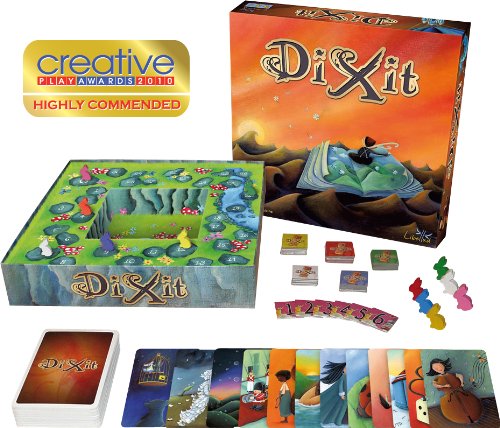
Dixit was a surprise to us for our wedding. We had never heard of it but now that we know it, we love it.  It's fun, not too long and has all that whimsical fairy tale art. The game is sort of similar to Apples to Apples and Balderdash, but I'd say more fun than either (though unlike those games, it's not a game for a large party). The active player chooses a picture card from his hand, and says outloud a clue for the picture which is vague, but not too vague. The other players look in their cards and find a picture from their hands which could also fit with that clue. When all of the players have chosen cards, the chosen cards are shuffled and revealed, and all the players (except the active player) vote. But here's the catch. If the clue is too specific, like "Cello lady" for the first card below, all the players will vote for it and the active player gets no points. If the clue is too unrelated, something like "title" no one will vote for the active players card and the active player will still get no points. But, if the clue is just right, a little-but not too- vague, some but not all players will vote for it, and then the active player will get points. It's really fun and beautiful and it uses a totally different sort of intelligence than other strategy games.

 
Ticket to Ride is also pretty fantastic. I've played the (regular?) America version, but the one we got was the Europe edition. Both are excellent, and the rules are pretty much identical. Few minor changes on the Europe edition (makes it feel like they tried to improve on the earlier version, and it seems like they did a good job.) It's a game you can have real conversations over because everyone's game play is pretty independent, and each turn is very short. My housemates and I played it for the first time a reunion weekend with some friends from undergrad, and over that weekend I think I played the game five times. It was just a great game to play while interacting, while other games are much more attention dominating. DixIt for instance IS your interaction while you are playing it, but Ticket to Ride is just as involved as you want it to be. Stay focused on your train routes and it will be a quicker game, but if you get all into your discussions about educational reform while playing? The game should still only take about an hour.

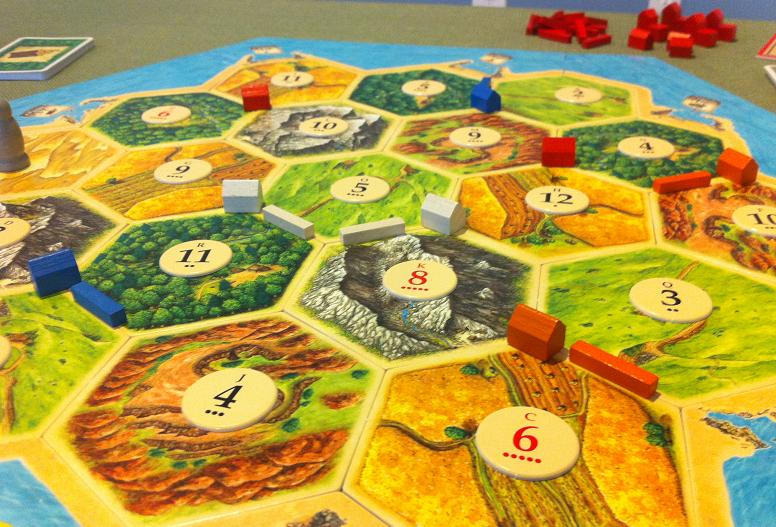
I think that most people know about Settlers of Catan at this point: a strategy game where you build settlements, barter for resources, hope for the right rolls of the dice so that you can get enough wheat to support your next settlement. It's a really nice blend of skill and luck, and though the turns are not short, everyone can participate in everyone else's turn (in a way that older games like Monopoly totally lacked). It has become a classic, and is played throughout the world. If you don't know it, ask a few friends, someone you know probably has it, and they'd almost certainly be thrilled to play it with you.

For those of you who already know and love Settlers,  7 Wonders is similar to Settlers, but... all boiled down. The rules are simple once you understand all the pieces and symbols, etc, but pretty scary when you first start. However, when everyone knows how to play, it's a quick game- 30 to 45 minutes, typically. There's a "Watch It Played" video on youtube for 7 wonders which is long (about half an hour) but will teach you the rules so well that you will be able to play the game after watching it. And if you still don't feel comfortable, you can watch the subsequent videos of the dad and his kids playing together, stopping to explain along the way. Also it can be played with only two players, a real plus for couples. Also, it is one of the most beautiful board games I've ever played. I really like it, and hope more people find out about it. When you get your hands on a copy you'll be rather impressed by the wallpaper of awards on all sides of the box. It just swept the international board game awards, and with good reason.

Apples to Apples is another one we received, and love. It's especially good for large parties or when people are getting to know one another. This game is an American game, I believe, so I think more people know about it than some of the German ones. I've also seen the cards re-purposed for hilarious photo shoots?

Other games I've played once or twice but really liked are Bang, Metro, Citadels, Caylus, etc. Ones which are smaller (in price, size, time commitment, etc.) which we really like are IZZI (more of a puzzle than a board game), Tantrix, Set, Flux, Quiddler, Timeline-we have the "Diversity" version. I'll tell you a little about a few of them:

Set- It has its own sets of cards with patterns and symbols and it's a game of organization and quick thinking. I love it. Quick, smart, fun. Easy to learn and play without getting repetitive, and good for kids too.

Quiddler - also a game played with cards by the makers of Set, this one feels like the doubly blessed child of scrabble and gin rummy. I like it better than both of its parents, and it's portable, fun, and easy to play.

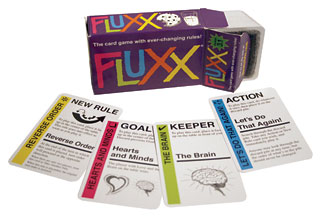
Flux - this game is a wild little thing. Much like Calvin Ball (from Calvin and Hobbes), this game's rules and goals change constantly with the cards the player choose and lay down. The goals are goofy things like "melted chocolate" -both the "sunshine" and "chocolate" cards need to be in play- and the rules are full of funny details if "it's a holiday or anybody's birthday take an extra card." Again, just played with it's own little deck of cards. If the regular version seems too run-of-the-mill for you, the cards also come in many varieties such as Oz and Pirates.

How about all of you? What games have I missed? What games do you like?