Showing posts with label Updates. Show all posts

Wednesday, October 5, 2016

Announcement: Owen's blog is moving

Hello dear friends! This is just a brief announcement to say that I'm moving my blog to my new website, which as of this writing is mostly empty but for the blog posts I've copied there.

You can find my new posts, including today's (Three ways to do your to-dos) here:

http://owenbiesel.com/blog


Does He Collect Butterflies will go back to being Clara's blog with the occasional guest post by me. Thanks for reading!

Wednesday, September 28, 2016

Optimization Metrics

Clara and I have to take a written exam in order to transfer our driver's licenses to Minnesota, so we're studying the Minnesota driver's manual. In the section on crosswalks I found this instruction:


The problem is that you can't leave an intersection both as quickly as possible AND as safely as possible. To leave as quickly as possible would be to sprint the last few yards, raising the chances of tripping and falling. To leave as safely as possible would mean walking slowly and carefully, constantly scanning your surroundings for new dangers, which is not particularly speedy.
       
This curve represents the boundary of your possible choices for how to cross the street. Anywhere inside the curve, you can increase either your speed or your safety, or both. Combinations of speed and safety outside the curve are beyond your ability, such as trying to go both as fast as you can and as safely as you can, the way pedestrians in Minnesota are charged to do.

Of course, no one is really bothered by this in practice; what we actually do is something like "leave the intersection as quickly as possible while still staying reasonably safe."
     
But this is only one way of solving the problem: you could decide instead that you need to leave reasonably quickly and then go as safely as you can at that speed. And either way, the choice of how safe is "reasonably safe" or how quickly is "reasonably quickly" is a little arbitrary.

Anyway, the reason I'm bringing this up is to try to make clear the idea that even if two people value the same things, they might disagree on where to allocate their efforts. This is especially relevant these days, as so many people seem to be talking past each other about what they want for our country. We all want everyone to be better off, but there are many ways to gauge the wellbeing of a population, and you can't optimize them all at the same time. Here are some examples:

  • How good the best are. This is how we compare countries in the Olympics, for example.
  • How good the average are. This is what we are thinking of when we worry that U.S. students are falling behind those in other countries regarding their math scores, or when we compare different countries based on their GDP per capita.
  • How good the total is. If a life is valuable in itself, then all things being equal a larger population is preferable to a smaller one. Measures along these lines include total GDP; policy based on improving that might involve promoting birth rates so we have a larger workforce.
  • How bad the worst are. If we want to improve the minimum quality of life in the country, we should concentrate all our efforts on those people who need our aid the most.
  • How far apart the best and worst are. If we want everyone to have equal resources, then we should keep on robbing the rich to give to the poor until there's no difference, regardless of where that middle point ends up being.
  • How many people fall below a certain threshold. If we've drawn a poverty line and only want to reduce the number of people below it, it's better to adjust handouts so that everyone just makes it above the line, regardless of how much worse off those above the line end up being.

One of these may sound more like your preference than another, even though they're all based on some way of trying to make things better for everyone. It's impossible to optimize with respect to two different metrics at the same time, so you have to choose what to fix at "reasonable" and what you optimize given that, and the choice of "reasonable" is a little arbitrary. So next time you're in an argument with someone, please remember that they might just be trying to optimize according to a slightly different metric, and just because they disagree with you doesn't mean they don't value the same things.

Monday, September 12, 2016

The quest for a dresser

We are making great strides in moving in. We have a books on our shelves, hooks for our keys, and cookies in the cookie jar.

But one of the things that was surprisingly difficult for us was finding a dresser. Most of our furniture came from IKEA, and we were able to check out the various options in the IKEA in Haarlem before we left the Netherlands. That way, we were able to get our new apartment pretty much mapped out before we came.


But while there's much more closet space here than in our place in Leiden, the rooms are more square, so wall space, not floor space, is at a premium. That means using taller, narrower storage whenever possible, so we wanted one of these dressers from IKEA:


But when we looked to see what was available in the states, what we found was more like this:


Where are all the tall, narrow dressers? IKEA isn't offering them anymore in the U.S., the country where they have been sued for the wrongful deaths of several small children who have been crushed in the last few years by chests of drawers tipping over. When we went on our big trip to IKEA last week, signs exhorting customers to affix their furniture to the wall were everywhere.

My knee-jerk reactions:

  • "I don't have children! Why shouldn't I be allowed to buy furniture for myself, just because someone else might do so irresponsibly?!"
  • "The furniture already comes with brackets to mount it to the wall, and the instructions include that step!" (Sure I've ignored that step in the past—living in a cinderblock dorm room does tend to prevent one from making any kind of hole in the wall—but the consequences of that neglect are my responsibility!)
  • "If IKEA really were contrite about these deaths, they'd pull the furniture line everywhere, not just in the one country where they got in trouble!" (It's as if, when they rolled out the slimmer and eco-friendlier KALLAX replacement for their iconic EXPEDIT series, they had only done so in countries that are particularly uppity about environmentalism.)
  • "It's not even that big a problem!" I mean, yes, it is an enormous problem if it's your child, and apparently a child in the U.S. is killed once every two weeks by furniture tip-over, which is awful. But given that there are over 21 million children under the age of 5 in the U.S., this works out to a probability of about 99.99938% that your newborn will survive your furniture.  If we were looking at, say, the Netherlands instead of the U.S., at this rate there would be a high probability of no child ever being killed by an IKEA dresser.

But on reflection, maybe discounting the size of the U.S. isn't such a good idea. Maybe a big country, where precedents are set for many at once and where legislative decisions have an exceptionally wide scope, has an extra responsibility to err on the side of safety. Maybe that's why small countries should belong to supranational organizations that impose annoying regulations.

But what does all this mean for us? It means we got our dresser at a thrift store.

Monday, September 5, 2016

The unexpected things you need when you move in


This is the week we finally made the move to Minnesota, and so far it's gone wonderfully. We completed the two-day drive without incident, we've assembled six carts' worth of Ikea furniture (just the desk is left!)—we've even gone to the state fair:

That's right: all-you-can-drink milk for just $2.
There have been a few things that have been difficult for us, though. With all the packing, re-packing, purging, and shipping, we are frequently unsure where we put the [fill in the blank] or whether we kept it at all. So for future reference, we've been making a list of the items we don't usually travel with that would have been really helpful to have easily accessible when we arrived.
  • Scissors
We knew we would want to measure our apartment as soon as we got here, so we stopped by Target to get a tape measure right before we left Virginia. The only tape measure they had was the same price as a tool kit that also contained a tape measure, so it was a clear choice to get the set. But far more useful than the tape measure have been the scissors—we have had so many boxes to open and packaging to cut through that it would have been a nightmare without them. The other tools have been useful too, what with all the furniture we've been assembling, but the scissors take the cake.
  • Water
We don't know yet how clean the tap water here is, so we've been really grateful for a 24-pack of water bottles my parents gave us right as we were heading out. Now we have a filter, so we have ready access to water we feel good about drinking, but in those first few days it was really helpful not to have to worry about how we would stay hydrated.
  • Plates/bowls/utensils
Seeing as we didn't want to eat out every meal, we were very glad that our plates and bowls were in some of the first few boxes we unpacked. All our silverware is in the shipment coming from the Netherlands, though, so we had to buy some inexpensive utensils to use in the interim. 
  • Can opener/knives/pot and pan/spatula
Again, we knew wanted to do some cooking, but didn't think about how we'd need tools to do it. It was a sad moment when we realized we'd bought canned beans to use for dinner and had no way to get at them. Fortunately one of our neighbors just moved in as well, and he had a spare one left by his previous tenant. Whew!
  • Soap
All kinds: dish soap, hand soap, bath soap, laundry detergent. It was embarrassingly long before we got all of those.
  • Paper towels and toilet paper—thanks for the tip, Keslei!
Clara and I each bought some of these paper products right away when we arrived, so it wasn't a crisis for us, but they were definitely handy and not something we usually travel with!
  • Quarters
While going through my old belongings at my parents' house, we found a film canister of quarters that I used to use for laundry. Turns out our laundry room here needs quarters too, as does the bus fare ($1.75 off-peak).
  • A place for dirty clothes
When we did finally do our laundry, we were pulling out dirty clothes we'd tucked away in all our bags and suitcases. No wonder we felt like we had no clean clothes! Don't be us. Keep the dirties in one place so you can wash 'em when you need to.
  • Shower curtain, liner, and rings
We have a shower curtain somewhere, but purchasing the other two (and more necessary) ingredients was another of those embarassingly belated tasks.
  • Lamps and light bulbs
Our living room doesn't have any built-in light fixtures, so for a while we just had to stop working there when it got dark. As of today, we have brought that room into the age of the electric light!
  • Checkbook
This really stands for all forms of payment—you never know when you might need cash or credit in an emergency—but the one we have been least likely to carry with us is our checkbook. These days we almost never use checks, but our landlord wanted a check for our first month's rent in exchange for the keys to our apartment. We ended up having to stop at a bank two states away and get a single page of three checks so that we'd have some when we arrived.

Thanks for reading! Anything I'm (still) forgetting? Any tips for the next stage of moving in, where the space is livable enough to get by but there's still a lot left to do? I'd love to know!

Friday, February 26, 2016

Moving to Minnesota!

This beautiful photo was available through m01229's flicker
This week, Owen and I decided to move to Minneapolis. The University of Minnesota English department has offered me a PhD position, which essentially means I will be paid to study and teach Shakespeare. This is a great joy. This is what I want to spend my whole life doing. This is reason enough to move, but there are many other reasons I'm excited for this new place to call home.

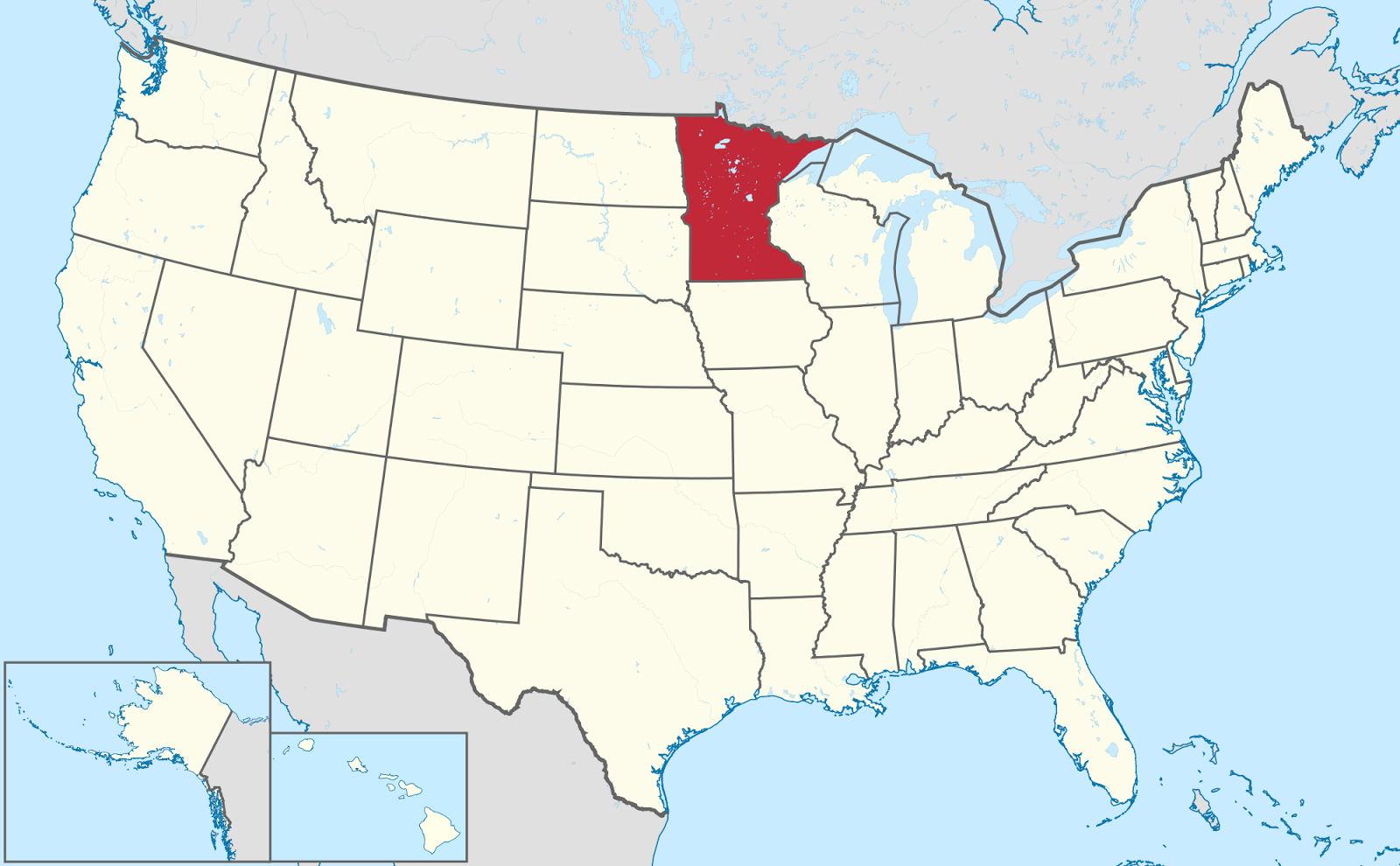
For my European friends: That's Minnesota.
One reason is a strangely sentimental layover from an odd chance on a new year's eve. When I was in grad school and Owen and I were still just dating I was supposed to fly out and spend the week with him and his family in Seattle. There was a blizzard in NYC, and my flight scheduled to go through JFK was cancelled, so I had to find a different flight through Minneapolis. As we landed it was a perfectly clear night and I got to see the sudden skyscrapers of the twin cities all lit and beautiful, and heard a mother from a seat behind me asking her daughter, "does it look like home?", in a comforting, midwest accent. And I was just a little overwhelmed that I was getting a glimpse of the place my parents had spent eight years of their lives. It was a 20 minute layover, but I think of it six years later with a great deal of fondness.

I can imagine you thinking, "So your parents lived there for a bit, and you have a happy memory of a layover there. What else is nice about Minneapolis? Isn't it just supposed to be super-extra cold?" I mean, yes. Yes, it is. But I like winter. I've dressed as winter at a costume party, and I grew up in Rochester, NY which has fierce winters. Not as cold as the midwest, I grant you, but cold enough to know it and miss it in the years I've been away. Yesterday it got below freezing here and I was so happy to be out biking in the snow I found myself singing out loud.


(If you're not convinced but want to look at lots of beautiful wintery pictures click here:  http://www.captureminnesota.com/galleries/1915)


This happiness, (however naive) is a great thing, because Minneapolis is one of the best cities for biking in the US, even ranks internationally in top 20 lists for biking cities, even considering the fact that it has brutally cold winters! You can read about one author's incredulity on this matter here. Their extensive bike-only freeways, their financial investment in making biking safe in the city, a prospering bike-share program, and mentality that biking is normal and expected make it much safer than elsewhere in the US.


People in Minneapolis are not just bikers, they're also readers. They're regularly listed as some of the most literate of American cities, ranked number one this past year by USA Today. I don't know how much time I'll have for pleasure reading on top of my regular coursework, but it will be such a joy to be able to be inside libraries of books I can read, and be surrounded by people who care about reading. And check out the beautiful new Minneapolis Central Library!

This will be me. 
There's such a great cultural scene in the Twin Cities! So much great theater! With a fringe festival! And Music! And excellent public radio! Although I am a little crushed to be moving to Minneapolis just as Garrison Keillor may be retiring from hosting A Prairie Home Companion (a radio show I grew up with, thanks to my parents' years in MN). In case you do not yet know the sound of Keillor's voice, let me introduce you via the Writer's Almanac.

We won't leave until the summer, but wherever live takes us, be it Minnesota or beyond, I hope to (as they say on the show) be well, do good work, and keep in touch. 

Friday, February 19, 2016

How to get to La Sagrada Família on a six-hour Barcelona layover

After Clara and I booked our recent trip to Rome, the airline changed our flight times and we ended up with a six-hour layover at the Barcelona airport on our way back. This airport is beautiful and calm and not a bad place to spend six hours if you want to get some work done*, but on this particular trip we wanted to make it into Barcelona proper to see at least one sight: Gaudí's masterpiece basilica, La Sagrada Família.

Our first leg landed at noon and our second was due to depart at about six pm, so we had almost exactly six hours to make it to and from the city center. The internet was not very helpful in telling us how to get there, so I'm sharing what we learned in hopes it will benefit someone else. What follows is how we spent our time, hour by hour:

12:00-12:30: Get off the plane and follow signs for public transit.
We were aiming for a bus, but found ourselves at the metro: this turned out to be a great discovery as the metro connection to the airport seems to be relatively new.

You'll need two Aeroport-metro tickets per traveller: one for the way there and one for the way back. As of this writing, each ticket costs €4.50.

12:30-1:30: Take the metro to the Sagrada Família stop.
To do this you can take the L9 Sud line all the way to Collblanc, where you ascend an infinite sequence of escalators to transfer to the L5. Take this line to the stop called Sagrada Família. We found it helpful to pass the time with games and snacks.

1:30-2:00: Eat lunch.
We got cheese, bread, fruit, nuts, and chocolate at a grocery store about a block from the Sagrada Família metro stop and ate it on a park bench. For two people for lunch it was about 10-15 euros, not bad and very speedy!

2:00-3:00: Bask in the amazing church.
You don't want to skimp on this step.


3:00-4:00: Return on the metro the way you came.
Take the L5 line to Collblanc, then transfer to the L9 Sud and go all the way to the terminal where you originally entered: For us it was Terminal 1, the last metro stop on the line. It's extra important to hold onto your metro ticket for the return trip, because you'll need to feed it into a machine both when you enter at Sagrada Família and when you leave at the airport.

4:00-6:00: Your two hours at the airport before departure.
Congratulations! You've made it there and back again.

What made this possible: We entered the basilica via the very short timed-ticket line by booking our tickets in advance. The tickets are for fifteen-minute entrance windows (we selected 2pm, so could enter anytime between 2:00 and 2:15), so we did some serious calculating trying to figure out the earliest time we could be reasonably confident of being there. Our flight was actually a half-hour late—we were supposed to have a 6.5-hour layover—so we're glad we included as much wiggle room in our estimate as we did.

*We know the Barcelona airport is so nice because our voyage to Rome had the same six-hour layover. Clara filmed one of her videos there in a spacious and nearly empty waiting area with amazing natural light, and I got a lot of work done on my applications.

Wednesday, July 29, 2015

Utah in July

—guest post by Owen

I'm spending the month of July at a giant once-every-ten-years conference in Salt Lake City, my first time back in the United States since moving to the Netherlands almost two years ago.  There have been experiences in every quadrant of the pleasantness/familiarity square:
  • pleasantly familiar: choice in grocery stores!
  • unpleasantly familiar: terrible-looking asphalt roads.
  • unpleasantly unexpected: lack of shade on the University of Utah's wide-open campus. 
Not pictured: the sun beating down relentlessly on every living thing.
But nothing has been so unexpectedly pleasant as the scenery.  Having heard about the Great Salt Lake, I imagined the environment of Salt Lake City to be the geographical equivalent of hard-water stains in the sink.  But it is actually quite beautiful, as I hope this photograph-laden post will convince you.

At a high elevation, there's not much atmosphere protecting you from the sun's rays, so it's easy to burn in the overhead sunlight.  A thin atmosphere also means, however, that it gets quite cool in the morning and evening, so a lot of people at the conference took the opportunity to hike up into the mountains on whose foothills the university rests.  Here's what we saw on one such trip:

From up here you can make out the Great Salt Lake in the distance.
This is the view looking the other way along the mountain ridge.
This past Saturday, several of us rode the earliest possible public transit to get to the Mt. Olympus trail.  The trail is only 3½ miles long, but none of us realized exactly how steep it would be: in fact, Mt. Olympus is the mountain to the left of center in the picture above!  After a few hours, we decided we hadn't brought enough supplies to make it all the way up, so we turned back after taking a group picture at the height we did attain:


The walk back to the bus stop was long and hot in the midday sun, but stopping to rest gave me the chance to photograph this guy, who is about as long as my index finger:


I want to close by showing pictures from two of the local attractions: Red Butte Garden ("Butte" is pronounced like "beauty" without the "-y") and its next-door neighbor, the Natural History Museum of Utah.

Red Butte contains so many different types of gardens, the two times I went I didn't see anything twice.  There's an herb garden, a rose garden, a medicinal garden, a five-senses garden especially for kids... all with signage that succeeds at being simultaneously informative and discreet.  There are places to wander on trails and places to sit under boughs of wisteria.


Some of the plants blew me away with their beauty, like these Blue Glow Globe Thistles:


And these miniature delights of whose name someone will have to remind me:


Then there's the natural history museum: it's located in a really well thought-out space, with interactive exhibits dedicated to the history of the earth (and especially Utah), the flora and fauna that are native to the region, and the indigenous peoples whose culture is still alive today.

But the star exhibit is the collection of dinosaur fossils!  I have never seen so many complete skeletons arranged in such stirring poses.  Some even swayed with the subtle currents in the air.
The fossils suspended in plates of rock are also beautifully arranged:


Several exhibits tried to give you the flavor of what it would be like to participate in an archaeological dig.  Here's a photo of a room where you could try to match cards to the grid squares beneath you, as if mapping an excavation.


I leave to fly back to the Netherlands on Saturday.  I'm so glad to be getting back to the home that I love, but I didn't think there would be so much here to miss too.  Thanks for reading!

Sunday, September 21, 2014

A Year in Leiden: Effort and Beauty


In Jeanette Winterson's incredible novel, The Powerbook, one of her characters writes, 

“There's no such thing as effortless beauty - you should know that. There's no effort which is not beautiful - lifting a heavy stone or loving you. Loving you is like lifting a heavy stone. It would be easier not to do it and I'm not quite sure why I am doing it.”

As I’ve thought about how to sum up our experiences here in Leiden this year, this quote came to mind again and again. There has been a lot of effort over things that don’t seem important or deeply meaningful, but there’s also been so much beauty that the effort itself (perhaps only in the haze of hindsight) can seem beautiful.


A lot of stuff this past year was really hard. Family sorrows, world sorrows, academic struggles, unemployment, loneliness. Some of it has been usual moving/adjusting difficulties, (the effort of filling out job application after job application, setting up the various things with town hall, unpacking a house, getting to know your way around your new city) but some of it hasn’t been. Watching new friends make the move had made us realise our transition was unusually difficult. Some of our new friends waited for a shipment for weeks, we waited for months. Bank accounts--which took us four trips to the bank, an additional trip to town hall, a seven-email conversation, a missed form, a delay because of vacation time and over 5 weeks total--took other people just one appointment to the local branch. We had to move within three months of coming. We were without internet for three months. It’s normal for these things to be difficult, but it’s not normal for them to be this difficult. I’ve gone to expat meetups that turn into pity-parties. “I’ve been miserable here for thirty years” is not the encouragement you’re looking for when you confess you’re really struggling to not feel sad.

The Hyperbole and a Half comic about depression started feeling really appropriate. But I’m not miles deep in the sadness either. I cry about as easily as the toddlers I babysit, but I laugh as easily too. And no, I am not pregnant, I am just Clara-the-easily-moved. I think I’ve always been this way, but I usually have feet a bit more solidly in my comfort zone.
Leiden in the late afternoon, in December

So now that I’ve shared a little of the effort, let me share a little of its beauty.

Board game nights: when the Italians bring Bang and then are totally shocked when we already know how to play.


Learning to Speak Dutch: Watching familiar kids movies like “The Emperor’s New Grove” dubbed in Dutch, and having it be something we can actually understand!
In the Escher Museum


Breakfasts: We sit down to pancakes pretty much every morning.


Babysitting: I’ve been able to help two children grow and learn. When we came little J wasn’t even born yet, but now I’ve seen him crawl and take some of his first steps.


Nights at home: We’ve read books out loud together (Villette, Ella Enchanted, To Kill a Mockingbird, What's so Amazing about Grace , to name a few), and watched a lot of Sci-fi (Dr. Who, Stargate, and Firefly, most of which I had never seen, but loved).


Making my mom's Greek Easter bread
Traveling: One of the greatest joys here is just being able to say, “Hey Owen, want to go to Belgium this weekend?” and have the answer be “sure!”


Museums: We have been to so many that even new museums in new places are starting to feel like friends we're only just now getting to meet.


Violin Lessons: I’ve started teaching two children once a week, and it’s been a blast.
King's Day!


Most of a first year of marriage: So much learning how to communicate, learning to be a team, learning to take care of each other, laughing, dancing, learning to love each other and this world better every day.


The Gym: We joined a super cheap gym and love remembering how good it feels to challenge one’s body.


Taking Owen’s calculus class: I’m in it again this fall and at more than half way through the course my average is an A-. Last year I wouldn’t have thought it was possible.


The Keukenhof: If you missed that post it’s worth it to go back for the pictures.


Owen’s work at the University: It’s great. He really likes his colleagues, his duties, the atmosphere and feels like he’s accomplishing more in less time than he ever did in graduate school.


Biking: Has begun to feel so normal, I already feel how much I will miss the biking when we return to the states.

Making Friends: Nothing makes you feel more at home than this. 

Cultural celebrations: This week I saw a parade with the royalty in their golden carriages, various military groups in gorgeous formal attire and dozens of children dressed in traditional dutch clothing, complete with little hats, bonnets and wooden shoes.


Houseplants: our "boompje" (little tree) is now taller than me!

Learning together: Besides learning Dutch, and learning from all the museums we go to, over dinner or breakfast sometimes we take part in online courses, the best of which was Barbara Oakley’s Learning How to Learn. We’re looking forward to a lifetime of learning together.


Our plan had been to stay in Leiden two years, and if we stick with that plan we have less than 12 months before we’ll need to move on. Owen recently was given the word that the University will happily extend his contract for up to five years total, so we could stay here much longer than we had planned. We’re not sure what we think about that, and we have a few months to think it over, but it’s made us do a lot of thinking about our time here. Do we want to stay? Is it the right choice for both of us? It's a real adventure learning to trust God, and trust each tother, but we know one thing for sure. If it's for just this next year or if it's for longer, we love it here, and it’s getting better all the time.

I didn't include it in the list, but I will say it here. Visits have been some of the best parts. Some of you are already planning trips, and we can't wait to see you. But if you’ve been thinking of coming to Europe, we’d love to show you around. We’ll share a little of the effort and the beauty of life here in The Netherlands.  

Thursday, March 6, 2014

Tour of our Apartment

I promise a more interesting post soon, but people have been asking for actual pictures of our apartment. Wish we could just have you over for dinner, a weeklong visit, or even just some tea, but in the mean time, I hope this little video will give you a taste for our new home. 


This is my first attempt at both shooting and editing film. I trust my skills will improve with practice.

Wednesday, February 12, 2014

Projects (Big and Little) for our New Place

You may remember from our Christmas post that we moved back in December. Here are some of the projects we've done to make the shell of a studio into more of a home. All of these are thanks to the loan of a powerful little drill from our Dutch teacher. 


Curtains

The first project we took on with this drill was hanging curtains. When we got the apartment we had this giant shopfront window and no curtains, or shades, nothing except some fuzzy contact paper that didn’t even go all the way up to the top of the window! We ordered the curtains from a home-improvement store, and although they are simple, we like them very much. I did all the work of putting up the runners for the curtains. It was hard work, standing on a table on a kitchen stool and drilling up into the ceiling, (sunglasses to keep the dust out of my eyes) and since I was visible to people on the street from the shoulders up, I got lots of funny looks all day.

 Coatrack


Our place has no usable closet so we got this when we went to Ikea. We especially like that you can hang hangers on it when you have wet things to hang, or company.


Light fixtures

Not an impressive photograph, but putting up the light fixtures was a big accomplishment for the two of us. Three places in the apartment there were just wires sticking out of the wall or the ceiling waiting for us to do the work. Once we had a drill we deciphered the Dutch instructions, turned off and on the electricity and DID NOT EVEN SHOCK OURSELVES as we put in the lights.


Under-the-cabinet-bar-and-things

This is a small thing, but our kitchen is not overflowing with counter space so I did some research about how to best use the space, and the biggest suggestion was just to get stuff up off the counter when you can. If you can find a place to put the thing that would go in a utensil crock, put them somewhere else. Hang them up, like we’re doing here, or stash them in a drawer.  The beautiful hanging/folding dish rack was just a lucky find at Ikea (Part of the Grundtal set, if you're looking). I didn’t
feel good about drilling into the tile wall to mount the rail all these things are hanging on, so I drilled into the cupboards instead.

Pegboard

The biggest project by far was the peg board. It took all of one Saturday, both of us working hard, getting all the materials except the pegboard itself (which was its own adventure, let me tall you!), sawing the lumber at the rusty out door saw at Praxis, biking with 200 cm planks attached to our bikes, and drilling all afternoon into concrete. Here are some pictures of the highlights.


We need the planks because if you try to just install a pegboard flat onto the wall, there’s nowhere for the hooks to slide through to and hold on. It looks so easy with the lumber on the floor.


Here we are with one plank up, and the other five taped into place.


There were a lot of hours between that last picture and this next one. They involved tears and questioning of our own sanity and cursing our stupidity at thinking this was ever a good idea.


The last project (also accomplished on that achingly long day we put up the pegboard) was installing this wall-mounted table. I think our neighbors may no longer like us after all the hammerdriling at 10 pm.  It folds open when we need more counter space but goes away whenever it’s not in use.


Thanks to Owen’s mom and sister, we have hooks to put on the pegboard and after three attempts at purchasing paint – a story in itself! – we have it all arranged.


Many thanks not just to Marleen, (our lovely Dutch teacher) but also to Samuël and Kindra for taking Owen to the Mega Praxis. It’s really starting to feel like home.