Showing posts with label empathy. Show all posts

Monday, July 11, 2016

What to do when Facebook arguments suck you in

It's happened again: someone's made an inflammatory comment on what's clearly a totally reasonable Facebook post, and you feel your response buzzing in your fingertips. You have two choices: let them have it ("it" being a polite and measured rebuttal, of course) or walk away. The problem is that neither approach is really satisfying.

The problem with engaging
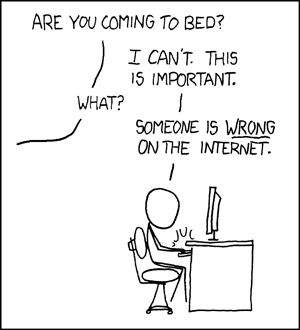


About a decade ago, I used to get in a lot of arguments on the internet. Back then, the debates I dived into were mostly academic, like whether a "neutral" English accent exists, or whether a plane really could take off from a treadmill (the latter, ironically, on the xkcd forums). The amazing thing is that even when you explain to someone that they're wrong, why they're wrong, and how they can be right in the future, they still don't change their mind! They can even seem more convinced of their own position than when you started. So why engage when it's a waste of time?

The problem with ignoring


There's one obvious problem with walking away: someone is still wrong on the internet. But there are subtler problems too. When we pay more attention to content with a worldview similar to our own, algorithms like Facebook's are designed to show us more of that. And when we see less and less of people who disagree with us, it's easier to reduce their views in our minds to simplified caricatures, really held by no reasonable person.


"You don't decide what gets in. And more importantly, you don't actually see what gets edited out."
But we don't even need an algorithm for this to happen. Even if we like having a mixture of perspectives in our lives, a slight desire not to be the odd one out can cause us to naturally segregate ourselves—for an interactive blog post on this idea, see the Parable of the Polygons, an allegory of small individual bias leading to large-scale intolerance.


I wonder whether these effects have to do with the rising levels of political polarization in the U.S. over the last decade.

So what can you do? If ignoring people creates division, and engaging doesn't necessarily help either, what's left?

Listen


It's easy to skim and jump straight into respond-mode. It's harder to pause and ask yourself what's going on in your friend's head—are they feeling angry? Frustrated? Hopeless? Even better: make a guess, and ask if you're right! "It sounds like you're worried that... Is that right?" You may find that there's something else going on than you thought.

And sometimes, showing that you're willing to hear their point of view means that they will spontaneously reciprocate. Since I resolved more often to reflect the desires people were expressing, I was surprised how often I found out they already were considering the viewpoint I'd wanted to share.

But since that doesn't always happen, I like to let go of the idea that victory is making sure your view is the last one heard. If everyone has that goal, no one wins. Instead, reaching a target of just one moment of understanding—even if it's you understanding them—is satisfying and leaves the internet a better place.

If you still feel the need to respond...


Okay, so sometimes you really, really want to make sure your views are also expressed. How can you do that without escalating to frustration?

  •  Dress your opponent as Iron Man

A straw man is when you attack a weaker version of someone's argument, so that you can win more easily. But the point is not to win, the point is to be right—so what's the rightest version of what they're saying? Show them that you get it, that they don't need to pull out the rhetoric in case you haven't heard it before.

  • Share information, not counterarguments.

After you've shown them that you understand where they're coming from, only then are you in a position to explain why you disagree. But in the spirit of honest communication, don't just pull out the standard rhetoric of your side. Better is to share the facts that caused you to join that side in the first place. After all, that's what convinced you.

I came across a nice summary of this conversation style in a blog post by Eli Dourado on why experts don't always agree:
Someone who is really seeking the truth should be eager to collect new information through listening rather than speaking, construe opposing perspectives in their most favorable light, and offer information of which the other parties are not aware, instead of simply repeating arguments the other side has already heard.

And while you're at it...


Part of the reason these techniques are so effective—listening carefully to the emotions underlying differing viewpoints, rephrasing your opponents' arguments to sound as honestly convincing as possible, and sharing information that might shed light on why we are disagreeing—is that they have the uncomfortable benefit of making it more likely for us to change our own minds in the process. Because we all have to be willing, at least a little bit, to change our minds, if you want our friends to do so too.

Saturday, February 6, 2016

Empathy and action: thoughts on old news.

Let me open these reflections with a story. During the horrifically devastating 2004 Tsunami I remember my sister and my mother having quite different reactions to the news. My sister was visiting home at that point (I believe it was near Christmas?) and she was glued to the computer, watching as the death toll rose, just stricken and horrified by the immensity of the tragedy. My mother took the little old Hungarian lady out to go grocery shopping. Both of them were a bit peeved at each other. My sister, because my mom wasn't paying attention and didn't seem to care about this massive tragedy, and my mom because she didn't see my sister's tearful observation as useful or helpful, whereas helping Mrs. Jakob, an elderly lady with no car, was both a necessity and a way in which she could actually lessen the need of the world. Before it sounds like I am slamming either of family members, let me clarify. If there is a villain in this story, it's me. I was also mildly peeved at my sister, but only because her using the only computer connected to dial up prevented me from AIMing with my friends. My sister is generous with her talents and her resources, my mother listens with knowledgeable concern to the affairs of the world. But at that moment my sister was empathizing, my mom was moving her feet, and they were both frustrated at each other for not responding to the tragedies and needs of the world in the same way.

The Peace Palace displays a French flag in flowers after the attacks
In the past few years I've been seeing a lot of similar conflict not in my household but in my newsfeed as people respond to the news in different ways. Because our world is much more connected now even than it was twelve years ago, and I can listen to the news from everywhere not just my hometown or home country, and this raises a lot of questions about what should be newsworthy. In the aftermath of the terrorist attacks in Paris, the world, and as follows, the internet flamed with a gigantic flare of empathy and solidarity for the city of Paris. And immediately following rise was a criticism of that very empathy. Personally? I found this criticism for the show of support of Paris a bit grating. Because on the on the one hand it feels like ragging on people as they express and experience their grief. No one quotes numbers and figures to one whose brother just died in a car accident. From where I'm living now, Paris is my neighbor, a mere 2.5 hours by train. I've visited Paris three times in the last 14 months. My friends live there. For millions of Americans, Paris is the only place outside the US they've ever been, the easiest place for them to picture in Europe. Of course everyone responds with grief.

But on the other hand, the criticism had some truth to it, because when similar acts of violence happen in other parts of the world, there is nothing close to the empathetic cry of solidarity. Paris feels like my neighbor, because it is close geographically and culturally to me. I've never been to Syria. I've never seen a film set there. I've read portions of exactly one book set in Syria and it was about the conflict. When I hear about a bombing in Syria I don’t immediately respond with shock and rage because that’s what I expect from news about Syria. Which reminds me of the Black Lives Matter movement-- a voice in America calling out against an expectation of violence against blacks, a more casual look at police violence if it concerns people who aren’t white. And again, here we find people not seeing other people as their neighbors, not empathizing with their sorrow. Because of course both of these things are wrong. Jesus calls us to consider as our neighbor not people we feel close to, but everyone. We make people our neighbors by showing kindness to them, by seeing their struggles as if they were our own, and by caring for their needs.

There’s been a lot of recent criticism of politicians saying that they’re praying for families who have lost loved ones, but consistently voting against laws that (these critics believe) would make the use of guns safer in this country. In December, media of all varieties was abuzz with comparisons of politicians calling for action, versus those merely expressing condolence or only prayers. And while accusations got a little ugly in this case I think this example continues to bring up some interesting questions about empathy. People say, “when you pray, move your feet,” but I think that it applies not just to prayers but to our feelings as well. How much do I get upset about something in the news because I fear that the people around me don’t seem to care? Maybe if I care extra, maybe if I am really, really, really sad about a tragedy involving someone who seems marginalized maybe that will make it better?

I recently read the somewhat mediocre novel, Sarah’s Key, and in this book an American expat living in Paris learns about French collaboration in the Jewish deportation. Her fascination with this history, and particularly the story of a particular girl becomes and obsession. At various times in the story it becomes clear that this story of this child is more important to her than her marriage, her daughter, her job, and it seems at the same time somehow noble and also unhinged. She wants to apologize, she’s sorry it happened, she’s sorry she didn’t know, she feels personally responsible somehow, if nothing else, for not knowing. This journalist character is full of feeling but none of it is productive.

To contrast with this fictional journalist’s emotional fixation, the Resistance Museum in Amsterdam tells the evocative stories of the Dutch under the Nazi occupation. One temporary exhibit was about the “hunger winter” and the children sent away from their families in city. They were sent to households in the country not because of air raids, like in London, but because The Netherlands is a small densely populated country and everyone was in such danger of starvation at the end of the war. The exhibit followed the stories of eight children, told in text and video by the now aging men and women themselves. You could watch videos of an old woman talking the time when she was just seven years old standing in line to get food and seeing someone keel over, dead of starvation right in front of her. You followed these children and their stories through the exhibit, seeing photos of their thin frightened faces, watching the elderly men and women cry at their memories, and every part of it was hard to watch. One child was sent to a part of the country where they speak not Dutch but Frisian, and when he returned to his family, could no longer remember any Dutch, another returned to find his siblings had all died, just heartbreaking stories every one of them. Then at the end of the exhibit, when I was all ready for closure and the happy ending, in the past there was a display about children dying of hunger today. Not many Dutch children starve these days, but children elsewhere do. The museum called for donations, and for activism. They wanted to transform all of the easy empathy we’d found by listening to sweet old Dutch ladies into food for hungry stomachs in Zambia or Tajikistan.

I was devastated by the end of this exhibit, but also incredibly impressed because learning to feel with another person’s hurt takes effort and determination, and it’s not any fun. They’re two distinct steps: the empathy and the action, but they’re both important, and they go hand in hand, because it is very hard to fill a need, to soothe a hurt if you do not see it. I hope that more and more I will be someone who is active in my engagement with this world. Conscientious, well informed, and especially quick to listen to those with whom I may disagree. When I pray (or cry, or empathize) I want to move my feet.